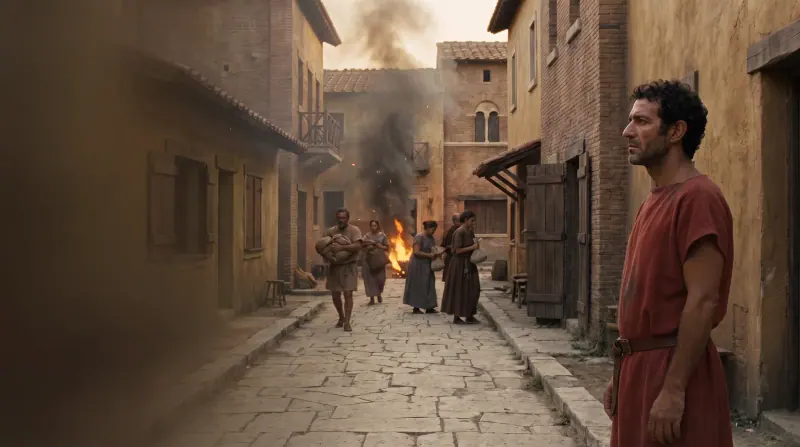
Where did the Great Fire begin, and why did it spread?
Tacitus places the outbreak in shops beside the Circus Maximus, between the Palatine and Caelian hills. These premises contained goods that burned readily. Driven by wind, flames moved along the Circus and into the surrounding city. They crossed lower ground, climbed slopes and reached areas whose residents had thought themselves safe. The connected urban fabric made a local outbreak a citywide emergency.
Rome combined monumental stone buildings with dense domestic and commercial streets. Narrow lanes, irregular routes and adjacent buildings complicated both escape and efforts to contain a spreading fire. The grand public image associated with Augustus’s imperial capital should not obscure the lived city of shops, rented rooms and vulnerable households. Tacitus’s account emphasizes these physical conditions before describing the political accusations that followed.
Evidence: Tacitus · Annals 15.38–45
What happened to people trying to escape?
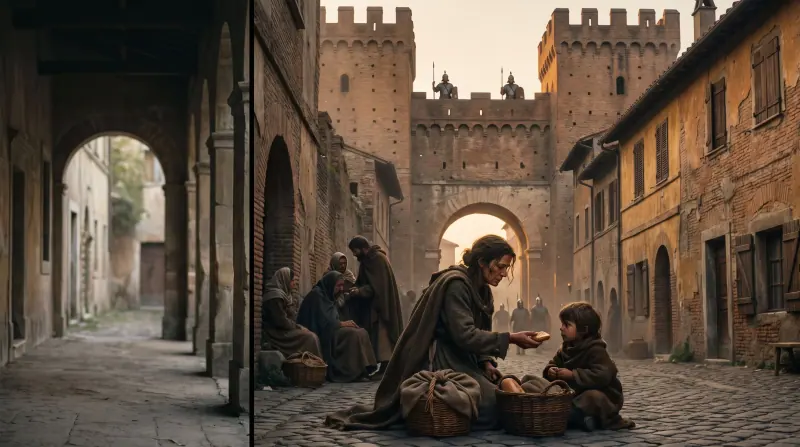
The most immediate danger was uncertainty about where to go. Tacitus describes people looking behind them while flames approached from another direction, or reaching a neighboring district only to find it burning too. Those helping elderly relatives or children had to move at the pace of the people they supported. Crowds and hesitation could obstruct routes even without an organized enemy blocking them.
The losses were larger than buildings alone. Homes also contained food, tools, money and the materials needed to earn a living. Losing them meant dependence on emergency shelter and grain. Tacitus describes some residents refusing to leave relatives they could not rescue. These passages are literary accounts rather than individual case files, but they preserve an essential feature of the catastrophe: choosing an escape route and keeping a household together could become different, competing tasks.
Evidence: Tacitus · Annals 15.38–45
How long did the fire last, and how much of Rome burned?
Tacitus says the main conflagration was checked on its sixth day when buildings near the Esquiline were demolished to create a broad open space. The destruction of property could therefore help halt further destruction. A renewed outbreak followed in a less densely populated area, causing further damage to temples and porticoes. The often repeated description of one uninterrupted fire masks this sequence of containment and renewed danger.
Of Rome’s fourteen administrative districts, Tacitus says four remained untouched, three were completely devastated and seven retained only badly damaged buildings. These are an ancient author’s summary categories, not a modern parcel-by-parcel survey. They support the scale of the disaster without proving that every structure in a named district disappeared. No reliable total number of deaths survives, so precise casualty figures should be treated with particular suspicion.
Evidence: Tacitus · Annals 15.38–45
Did Nero start the fire or perform while Rome burned?
Tacitus explicitly reports uncertainty between accident and deliberate action by the emperor. He also records stories of people preventing firefighting or throwing firebrands while claiming authority. Such conduct might reflect orders, looting or other circumstances; the account does not establish a chain of command proving Nero ordered the initial outbreak. Suspicion increased when a later fire began on property associated with his associate Tigellinus.
Suetonius is more accusatory and portrays Nero watching the destruction while performing a song about Troy. Tacitus presents the performance as a circulating report. Both wrote after Nero’s reign, and their hostile portraits cannot be treated as direct recordings of his conduct. The familiar phrase about Nero “fiddling” is not a literal description of the ancient instrument tradition. The historical question concerns an alleged theatrical performance, and even that allegation remains unverified.
Evidence: Tacitus · Annals 15.38–45 · Suetonius · Nero 31 and 38
Nero’s relief effort and the rebuilding of Rome
According to Tacitus, Nero was at Antium when the fire began and returned as it approached his property. He opened the Campus Martius, public buildings and his gardens to displaced residents. Temporary shelters were erected, supplies were brought from Ostia and nearby towns, and grain was made available at a reduced price. Acknowledging these actions does not erase other abuses of his government; it prevents a rumor from replacing the documented complexity of the response.
Rebuilding brought wider streets, limits on building height, more separation between properties, greater use of less combustible materials and attention to water available for firefighting. Nero also developed the enormous palace complex known as the Domus Aurea, or Golden House. That appropriation of space fed distrust. Public protection and imperial display proceeded together, while the cost of construction created further demands on Italy and the provinces.
Evidence: Tacitus · Annals 15.38–45 · Suetonius · Nero 31 and 38
Why Christians were persecuted after the fire
Tacitus says Nero sought to divert persistent accusations by punishing Christians. He describes arrests and exceptionally cruel public executions. The historian himself expresses hostility toward the group, yet also reports sympathy for victims who seemed to be suffering for an emperor’s cruelty rather than the public good. His language must therefore be distinguished from an endorsement of the charges.
The passage is evidence for persecution and the politics of blame, not proof that Christians caused the fire. Nor should the episode be turned into a simple claim that all Christians across the empire faced an identical policy at that moment. The later change in imperial patronage associated with Constantine’s victory at the Milvian Bridge belongs to a different period, almost two and a half centuries afterward.
Evidence: Tacitus · Annals 15.38–45
Why the disaster mattered beyond Nero’s reign
The fire changed how parts of Rome were built and how Nero was remembered. It destroyed old religious sites and treasured objects as well as ordinary dwellings. Replacing structures could not restore everything residents associated with their city. The gap between an improved plan and the experience of dispossession helps explain why reconstruction alone did not settle arguments over responsibility.
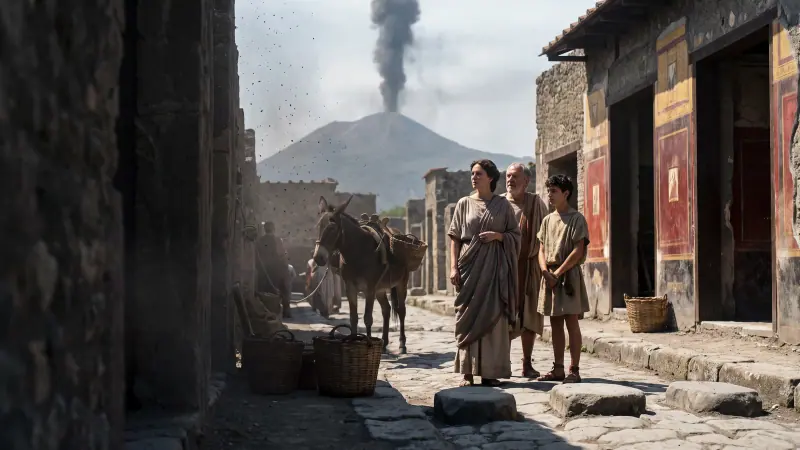
Comparison with the eruption that buried Pompeii in AD 79 shows the importance of distinguishing kinds of evidence. Rome’s fire is reconstructed chiefly through later literary narratives and the city’s building history; Pompeii also preserves extensive deposits and human remains from the disaster itself. Neither event should be reduced to a spectacle detached from its survivors and the limits of what can be known.
Evidence: Tacitus · Annals 15.38–45
Timeline
- July AD 64
Fire breaks out in the Circus district and spreads rapidly through crowded neighborhoods.
- Early in the disaster
Nero returns from Antium; temporary accommodation and food relief are organized.
- Sixth day in Tacitus’s account
Demolition creates an open area near the Esquiline and checks the main fire.
- After the initial containment
A renewed outbreak damages further areas, including temples and porticoes.
- Following the fire
New street and building rules accompany reconstruction; work begins on Nero’s Golden House.
- Aftermath in AD 64
Tacitus describes Christians being accused and subjected to brutal public punishments.
Questions people ask
When did the Great Fire of Rome happen?
It began in July AD 64, conventionally on the night of 18–19 July. Tacitus describes the main fire being checked on its sixth day, followed by a renewed outbreak.
Did Nero burn Rome deliberately?
That has not been established. Tacitus records competing explanations, while Suetonius directly accuses Nero. The existence of an ancient accusation is not enough to prove responsibility.
Where was Nero when the fire began?
Tacitus says he was at Antium and returned to Rome as the fire approached his property. The same account describes him organizing accommodation and food relief.
Did Nero fiddle while Rome burned?
The familiar phrase is not a literal ancient report. Ancient authors discuss a story about Nero singing of Troy’s destruction; whether such a performance happened is uncertain.
Was all of Rome destroyed?
No. Tacitus reports that four of fourteen districts escaped, three were devastated and seven were damaged. His categories describe extensive destruction without supplying a precise building count.
How many people died in the Great Fire?
There is no reliable surviving death toll. Ancient accounts describe serious human losses and mass displacement, but do not justify an exact modern casualty figure.
Did Christians cause the Great Fire?
The evidence does not establish that. Tacitus presents their punishment in the context of Nero’s effort to redirect blame and describes cruelty that aroused sympathy for the victims.
Sources and perspective
Sources are identified beside the sections they support. Ancient and medieval authors wrote from particular positions; a detailed story can still be partisan, late or uncertain. Archaeology can test an account without confirming every detail.
- Tacitus · Annals 15.38–45
The main narrative of spread, relief, extent, rebuilding and persecution. Written decades later; explicitly uncertain about the fire’s origin and hostile toward Christians.
- Suetonius · Nero 31 and 38
Later biography directly accusing Nero and describing the Golden House. Its sensational claims need comparison with Tacitus, not automatic acceptance.
Published . Updated . Research, authorship and corrections.
Report a historical correctionKeep your place in history.
Reading progress stays in this browser, on this device.
Choose your next episode