Pompeii before the eruption
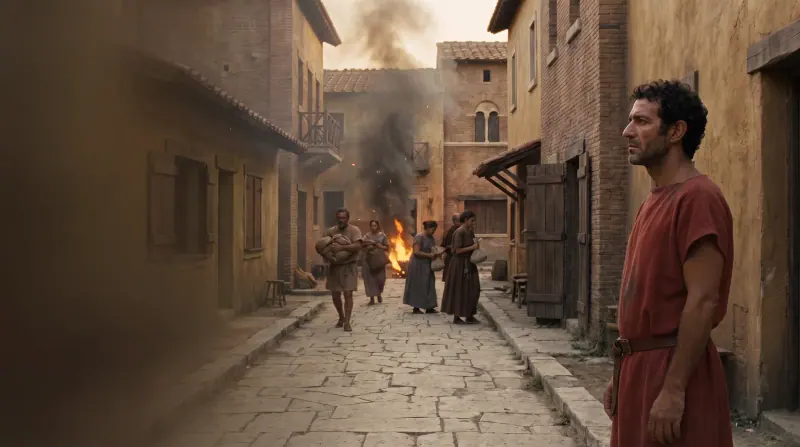
Pompeii was a functioning town of houses, workshops, shops, baths and public buildings. Its inhabitants lived within a Roman world that had developed through the Republic and the imperial order established by Augustus. The archaeological record preserves daily work and domestic life as well as elite decoration. The city’s destruction matters partly because it exposed a cross-section of those activities, rather than only the monuments a later generation chose to preserve.
The region had experienced earthquakes before AD 79, including a major destructive event usually dated to AD 62 or 63. Pliny recalls that tremors immediately before the eruption did not at first cause exceptional alarm because shaking was familiar in Campania. Familiarity with one hazard did not provide a scientific model for the eruption that followed. We should avoid assuming residents understood the danger as a modern observer would.
Evidence: Pliny the Younger · Letters 6.16 and 6.20 · Sparice and colleagues · Earthquakes during the AD 79 eruption (2024) · Pompeii Archaeological Park · The casts
What happened when Vesuvius erupted?
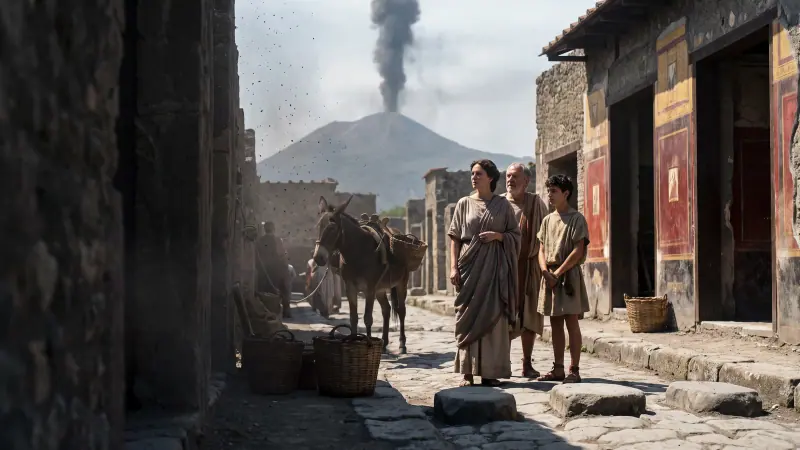
The eruption sent volcanic material high into the atmosphere, producing the towering column Pliny compared to a spreading pine tree. Falling pumice and ash accumulated around the volcano, with effects differing by location. At Pompeii, deposits loaded roofs and obstructed movement. Later pyroclastic currents, fast-moving mixtures of hot gas and volcanic particles, swept through and buried the city further.
Destruction therefore had several mechanisms. Buildings could collapse under accumulated material; violent shaking could worsen structural failure; volcanic currents brought lethal heat, particles and impact. Recent research at Pompeii identifies earthquake damage during the eruption itself. The Italian Civil Protection Department describes the overall AD 79 event as lasting less than two days. That broad duration does not mean every town had the same sequence or the same opportunity to escape.
Evidence: Pliny the Younger · Letters 6.16 and 6.20 · Italian Civil Protection Department · Eruptive history of Vesuvius · Sparice and colleagues · Earthquakes during the AD 79 eruption (2024)
Pliny the Elder’s rescue voyage
Pliny the Younger was at Misenum with his mother and his uncle, Pliny the Elder, who commanded the fleet there. The unusual cloud first prompted the elder Pliny to prepare a closer investigation. A plea for help from a woman named Rectina changed the purpose of the voyage, and he ordered larger vessels toward the threatened shore to assist others as well. His nephew stayed behind.
As the ships approached, ash and stones fell and conditions near shore became difficult. The elder Pliny went to Stabiae, where Pomponianus was trying to leave but faced unfavorable wind. The letter describes anxious decisions about remaining indoors under shaking buildings or going outside amid falling debris. Pliny the Elder eventually collapsed and died. His nephew’s account of those final moments depended on information from others, and its explanation does not establish a certain modern medical diagnosis.
What Pliny the Younger saw, and what he did not
The younger Pliny’s second letter describes his own experience with his mother. Intensifying tremors drove them outside. Carts could not be kept steady, the sea appeared to draw back, and a threatening cloud advanced. Darkness became so complete that people called out to recognize relatives by their voices. Pliny describes repeatedly shaking off accumulating ash and a mixture of real danger, rumor and fear.
These letters are indispensable eyewitness evidence for conditions around Misenum and a reported rescue voyage. They are not eyewitness descriptions from a street inside Pompeii. Written later to the historian Tacitus, they also commemorate the author’s uncle and shape experience into a coherent narrative. Using them responsibly means distinguishing direct observation, reported events and the modern geological reconstruction of places Pliny did not visit.
Did people escape Pompeii?
The eruption did not kill everyone around Vesuvius at one instant. Pliny and his mother survived, and the letters describe other people moving away from danger. At the same time, a decision to shelter could seem sensible when falling stones threatened people outdoors, only to become disastrous when structures failed or later volcanic currents arrived. Access to transport, mobility, companions and the timing of departure all mattered.
The excavated dead cannot be treated as a census of the entire population, and an absence of remains cannot identify every survivor. Nor can a person’s possessions reveal a complete motive for staying. The record permits an account of changing hazards and unequal choices without inventing biographies. This is also central to understanding escape during the Great Fire of Rome: knowledge that a catastrophe happened does not tell us what each resident knew when a decision had to be made.
Evidence: Pliny the Younger · Letters 6.16 and 6.20 · Sparice and colleagues · Earthquakes during the AD 79 eruption (2024) · Pompeii Archaeological Park · The casts
Was the eruption in August or October?
The year AD 79 is secure; the day and month remain disputed. The traditional 24 August date comes from the textual tradition of Pliny’s letter. An archaeological park research discussion published in 2024 stresses the strength of that manuscript reading while explaining why archaeological evidence has encouraged an autumn date. The charcoal inscription often cited in this debate has a day and month but does not by itself settle its year.
The same discussion warns that the frequently repeated date 24 October does not follow securely from the manuscripts. Seasonal finds and other evidence need contextual interpretation. The responsible conclusion is an unresolved disagreement, not the replacement of one unqualified date with another. A chronology can explain the eruption’s phases without assigning every phase to a modern calendar day.
Evidence: Pompeii Archaeological Park · The date of Pompeii’s destruction (2024)
What the casts and ruins preserve
The famous human casts are not people transformed into stone. Archaeologists filled cavities left when bodies decomposed within hardened volcanic deposits, preserving impressions of their forms; the history of making and restoring casts also affects what visitors see. Bones and other evidence require separate study. A pose alone cannot securely establish someone’s identity, relationship to another person or final emotion.
Pompeii’s importance is both archaeological and human. Excavated buildings and objects help study life before the catastrophe, while the deposits preserve evidence of destruction. These sources differ from the literary accounts surrounding Rome’s sack in AD 410, another disaster whose victims are often overshadowed by a grand story of decline. Pompeii asks us to read physical evidence carefully, without turning recognizable individuals into certainty where there is only a plausible interpretation.
Evidence: Pompeii Archaeological Park · The casts · Sparice and colleagues · Earthquakes during the AD 79 eruption (2024)
Timeline
- AD 62 or 63
A major earthquake damages Pompeii and neighboring communities; the precise year is debated.
- Days before the eruption
Pliny recalls tremors, which people in Campania were accustomed to experiencing.
- First day, AD 79
A tall eruption column develops; pumice and ash begin to accumulate in affected areas.
- First day into night
Pliny the Elder sails toward endangered communities; ash, falling material and shaking complicate shelter and escape.
- Later phases
Pyroclastic currents devastate settlements and add deposits over the fallen pumice at Pompeii.
- After the eruption
Survivors face a transformed region; Pliny the Elder has died near Stabiae.
- Centuries later
Excavation and scientific study reconstruct the city and continually revise interpretations of the disaster.
Questions people ask
When was Pompeii destroyed?
Pompeii was buried by Vesuvius in AD 79. The traditional date is 24 August, but archaeological evidence has prompted arguments for autumn. A specific October day is not settled.
Was Pompeii covered in lava?
No. Its burial resulted chiefly from falling pumice and ash and deposits from pyroclastic currents. A slow-moving stream of liquid lava is the wrong model for this disaster.
Did anyone survive the eruption?
Yes. Pliny the Younger and his mother survived at Misenum, and people escaped affected communities. The surviving evidence cannot provide a complete list or a precise survival rate for Pompeii.
How long did the eruption last?
The Italian Civil Protection Department describes the AD 79 eruption as lasting less than two days. The sequence and severity of hazards varied between towns and changed during the event.
Were the bodies at Pompeii petrified?
No. Many familiar figures are casts made by filling cavities left by decomposed bodies in volcanic deposits. They are archaeological records of bodily form, sometimes incorporating surviving skeletal material.
Was Pliny the Younger in Pompeii?
No. He observed events from Misenum across the bay. His account of Pliny the Elder’s last journey also uses information reported by other people.
Did Pompeii and Herculaneum suffer in the same way?
Both were devastated, but their positions relative to Vesuvius exposed them to different sequences of falling material and volcanic currents. Evidence from one town should not simply be transferred to the other.
Sources and perspective
Sources are identified beside the sections they support. Ancient and medieval authors wrote from particular positions; a detailed story can still be partisan, late or uncertain. Archaeology can test an account without confirming every detail.
- Pliny the Younger · Letters 6.16 and 6.20
Eyewitness experience at Misenum and a reported account of his uncle’s voyage, written later to Tacitus; Firth’s 1900 translation.
- Italian Civil Protection Department · Eruptive history of Vesuvius
Official overview of the AD 79 eruption’s broad duration and regional effects, not a street-level escape timetable.
- Sparice and colleagues · Earthquakes during the AD 79 eruption (2024)
Primary research distinguishing volcanic and seismic destruction. Findings at particular excavated buildings should not be generalized to every victim.
- Pompeii Archaeological Park · The date of Pompeii’s destruction (2024)
Italian research discussion of manuscript readings and archaeological arguments; explicitly cautions against treating 24 October as established.
- Pompeii Archaeological Park · The casts
The production, display, damage and restoration of casts; their appearance is not an unmediated photograph of death.
Published . Updated . Research, authorship and corrections.
Report a historical correctionKeep your place in history.
Reading progress stays in this browser, on this device.
Choose your next episode