When was the Colosseum built, and why there?
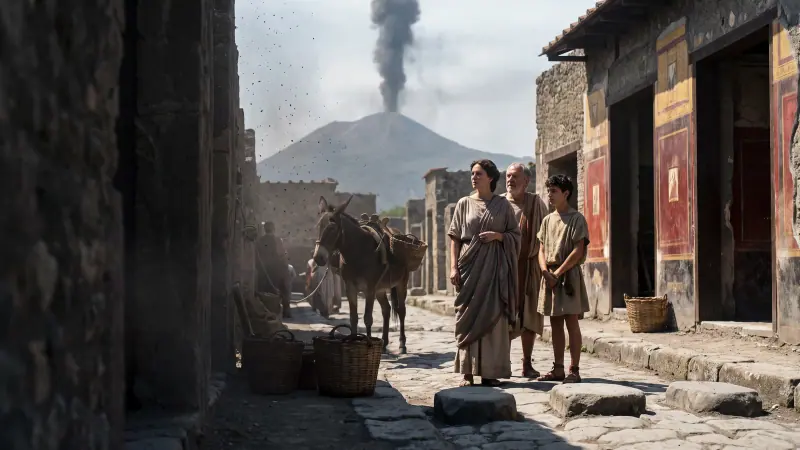
Work began under Vespasian, who became emperor in AD 69 after the civil wars that followed Nero’s death. Construction is usually placed in the early 70s AD. A fourth-century chronicle credits Vespasian with the lower levels and Titus with the upper storeys, although scholars have debated how far the building had risen when Vespasian died in June AD 79. Titus, whose short reign also saw the eruption of Vesuvius, dedicated it in AD 80. Domitian, who succeeded him in AD 81, completed further work.
The site was a political choice. After the Great Fire of AD 64, Nero built the Golden House, a palace landscape whose artificial lake filled this valley. In one of his poems on the amphitheatre, Martial contrasts the “ponds of Nero” with the building now rising in their place and declares that “Rome has been restored to herself”: what had delighted a master now delighted the people. Placing a public entertainment building on a fallen emperor’s private landscape let the Flavians present their rule as returning the city to its citizens.
Official park itinerary: Nero’s lake and the Colosseum valleyEvidence: Platner and Ashby · Amphitheatrum Flavium (1929) · Martial · Book of Spectacles (Bohn translation, 1897) · Parco archeologico del Colosseo · The Colosseum
Was the Colosseum paid for with spoils from Jerusalem?
Possibly, but the evidence is a modern reconstruction. A marble block in the Colosseum was reused in the fifth century for an inscription recording repairs. Its earlier metal letters had been removed, leaving 67 peg holes. In 1995 the epigraphist Géza Alföldy used the pattern of those holes to propose a lost text in which the emperor ordered the “new amphitheatre” to be built ex manubiis, “out of the spoils of war”. He argued that the text first named Vespasian and was later altered, with a T added for Titus.
If the reading is right, the spoils would most naturally be those of the war in Judaea, which ended in AD 70 with the destruction of Jerusalem and its Temple, the deaths of many people and the enslavement of captives. Yet no ancient author links the amphitheatre’s funding to that war. Scholars accept some restored words and doubt others. In 2026 Alison Cooley presented new high-resolution laser scans of the blocks, argued that Alföldy’s text is not the only possible reading, and suggested the inscription may instead record Domitian’s improvements to the arena. The Jerusalem reading fits the Flavians’ commemoration of the war elsewhere in Rome, but it is a hypothesis, not a recovered sentence.
Evidence: Judaism and Rome · Flavian amphitheatre inscription (CIL VI 40454a) · British School at Rome · Alison Cooley, Resurrecting a “ghost inscription” from the Colosseum (2026)
What happened at the 100 days of opening games?
Suetonius says Titus dedicated the amphitheatre, together with baths built hastily nearby, with a magnificent and costly gladiatorial show, and claims that 5,000 wild animals of every kind were exhibited in a single day. Cassius Dio, writing more than a century later, reports 9,000 animals killed, both tame and wild. He mentions fights between cranes and between four elephants, women, though not women of rank, taking part in killing animals, and both single combats and group fights. He says the spectacles lasted 100 days. These figures are ancient claims, not audited totals.
According to Dio, Titus also threw small inscribed wooden balls into the crowd; whoever caught one could claim the item named, from food and clothing to silver vessels, horses or enslaved people. Martial’s Book of Spectacles, a set of short poems on the amphitheatre’s shows, adds a rhinoceros, a woman fighting a lion, a celebrated animal fighter called Carpophorus, and condemned criminals put to death in scenes staged as myths. The poems address the emperor only as “Caesar”, so some may describe later shows under Domitian, but modern scholars often connect most of them with the opening games.
Evidence: Suetonius · Titus 7 · Cassius Dio · Roman History 66.25 · Martial · Book of Spectacles (Bohn translation, 1897)
Did they flood the Colosseum for sea battles?
The sources disagree in revealing ways. Cassius Dio says Titus suddenly filled “this same theatre” with water, brought in horses and bulls trained to move in it, and staged a sea fight between crews representing Corcyreans and Corinthians. He adds a larger battle, with 3,000 men, in the basin Augustus had dug outside the city. Suetonius mentions only a sea fight in that old naumachia. One of Martial’s poems tells a newcomer that the water before him had been dry land moments earlier. Ancient writers may have described the same events differently, or later accounts may have merged two venues.
The archaeological park accepts that water shows took place at the inauguration, when the structures beneath the arena floor were still built of wood. Under Domitian these were rebuilt in masonry as the hypogeum, a network of corridors, lifts and trapdoors that brought animals and people up into the arena. The park states that water shows were no longer held after that change. How the arena was filled and drained, how deep the water was and how often it was used remain unknown, so a flooded arena is possible but poorly documented.
Official park page on the underground levelsEvidence: Cassius Dio · Roman History 66.25 · Suetonius · Titus 7 · Martial · Book of Spectacles (Bohn translation, 1897)
What was a day at the Colosseum like?
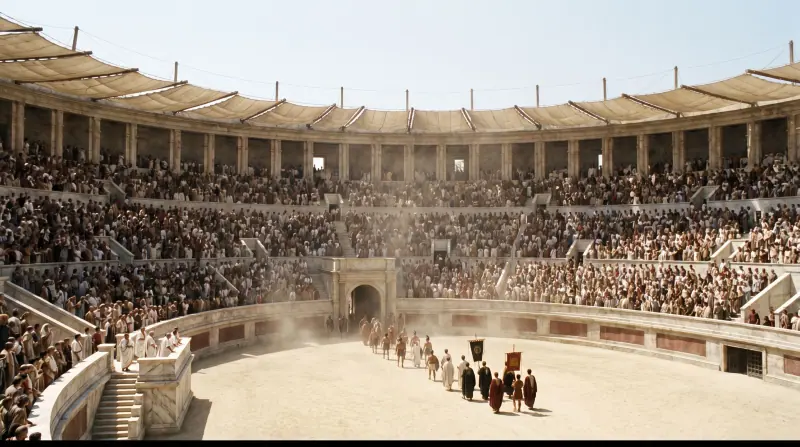
According to the archaeological park, entry was free. Spectators passed through 76 numbered arches, followed routes marked inside and used tokens (tesserae) held by the head of each family to reach their places. Seating mirrored Roman hierarchy. The emperor’s box stood on the short axis, senators sat closest to the arena, equestrians behind them, and lower-status groups higher up. The poorest sat on wooden benches or stood at the very top, under a colonnade. Inscriptions cut on surviving seats show places reserved for particular groups and officials.
The arena was open to the sky, but masts set in sockets around the top of the outer wall supported awnings, the velarium, to shade the seating. A day’s programme could combine animal displays, executions of condemned people and gladiatorial pairs, though no timetable survives for any single day of Titus’s games. Martial pictures spectators from distant peoples, speaking many languages but united in acclaiming the emperor. That is flattery, not a census, but it shows how the building was meant to display imperial generosity to the whole Roman world.
Official park page on the seating and entrancesEvidence: Parco archeologico del Colosseo · The Colosseum · Platner and Ashby · Amphitheatrum Flavium (1929) · Martial · Book of Spectacles (Bohn translation, 1897)
How many people did the Colosseum hold?
Probably around 50,000, but no ancient figure gives a reliable answer. A fourth-century list of Rome’s buildings credits the amphitheatre with 87,000 “places” (loca). Platner and Ashby’s topographical dictionary argued in 1929 that this figure cannot refer to individual spectators and is probably wrong even as a measurement. They estimated no more than 45,000 seats, with standing room for about 5,000 more at the top. Later estimates differ, but they generally fall well below the ancient total.
Estimates vary because they depend on assumptions about seat width, how closely people sat, how many stood and how the lost upper levels were arranged. The marble seating has almost entirely disappeared. Places were also allotted by length of bench rather than as a chair for every person: an inscription of AD 80 records space given to the Arval Brothers, a priestly college. The scale itself is clear: an ellipse about 188 by 156 metres, an outer wall about 48 metres high and 80 ground-floor arches, four of them main entrances.
Who were the gladiators, and did they always fight to the death?
Most gladiators were enslaved men, prisoners of war or condemned criminals, although some free people contracted to fight. They trained in schools; Spartacus led his revolt after escaping from one at Capua in 73 BC. Fights did not always end in death. A beaten fighter could appeal for release, and the sponsor of the games, often the emperor, decided. Martial describes Priscus and Verus fighting so evenly at the amphitheatre that the emperor sent each of them the wooden sword marking discharge from service and the palm of victory.
Two famous details are less secure. Latin writers mention a “turned thumb” without making clear which way it turned; the confident thumbs-down signal owes much to Jean-Léon Gérôme’s 1872 painting Pollice Verso. Martial instead refers to fighting ad digitum, until one man raised a finger to concede. The words “morituri te salutant” come from Suetonius’s account of men about to fight a staged sea battle for Claudius on the Fucine Lake in AD 52. They hailed the “emperor” (imperator), not “Caesar”, and nothing shows that gladiators regularly said it.
Evidence: Martial · Book of Spectacles (Bohn translation, 1897) · Suetonius · Claudius 21
Why is it called the Colosseum?
The name comes from a colossal statue that stood nearby, not from the size of the amphitheatre itself. The statue belonged to Nero’s Golden House, and it survived his fall: Martial’s poem on the site opens with the “starry Colossus” still standing beside the new buildings. The name passed to the amphitheatre only in the Middle Ages. Platner and Ashby place that transfer after AD 1000, long after the last games had been held.
Ancient writers usually call the building simply the amphitheatre. Suetonius speaks of Titus’s amphitheatre, and Dio, writing in Greek, calls it a hunting-theatre. The name Flavian Amphitheatre, used today by the archaeological park, links it with the dynasty of Vespasian, Titus and Domitian. The popular idea that “Colosseum” simply means “colossal building” is understandable given its size, but the evidence points to the statue. Martial, celebrating its shows, calls it simply “Caesar’s amphitheatre”.
Evidence: Parco archeologico del Colosseo · The Colosseum · Platner and Ashby · Amphitheatrum Flavium (1929) · Martial · Book of Spectacles (Bohn translation, 1897)
What happened to the Colosseum later, and can you visit it?
The building was repaired many times. A fire after lightning struck it in AD 217 closed it until about 222, and earthquakes in the fifth century and in 847 caused further damage. Gladiatorial combat ended in the fifth century, although the dates given vary; the last recorded animal hunts took place in 523. In the Middle Ages and Renaissance the ruin housed workshops and homes and served as a quarry, including for stone used in St Peter’s Basilica. It was also gradually Christianised.
Today the Colosseum belongs to the Parco archeologico del Colosseo, together with the Roman Forum, the Palatine and the Domus Aurea, the surviving pavilion of Nero’s palace. The standard ticket covers the first and second levels with the Forum and Palatine; the underground levels and arena need other ticket types or a guided tour. Entry to the Colosseum requires a timed reservation, and tickets are issued in the holder’s name. Check the official park website for current hours and prices before travelling, as arrangements change with the seasons.
Official Colosseum page Official opening times and ticketsEvidence: Platner and Ashby · Amphitheatrum Flavium (1929) · Parco archeologico del Colosseo · The Colosseum
Timeline
- AD 64
After the Great Fire, Nero builds the Golden House, a palace landscape with an artificial lake in the valley where the Colosseum now stands.
- AD 68–69
Nero dies and civil war follows; Vespasian emerges as emperor and founds the Flavian dynasty.
- AD 70
Roman forces under Titus capture and destroy Jerusalem during the war in Judaea.
- Early 70s AD
Vespasian begins the amphitheatre on the site of Nero’s lake.
- June AD 79
Vespasian dies and Titus becomes emperor. Vesuvius erupts later the same year.
- AD 80
Titus dedicates the amphitheatre and nearby baths with games that Cassius Dio says lasted 100 days.
- AD 81–96
Domitian completes the upper works and rebuilds the underground levels in masonry.
- AD 217–222
Fire after a lightning strike seriously damages the building, which reopens after repairs.
Questions people ask
When was the Colosseum built?
Work began under Vespasian in the early 70s AD. His son Titus dedicated the amphitheatre in AD 80, and Domitian completed further work, including rebuilding the underground levels in masonry.
How long did it take to build the Colosseum?
Roughly eight to ten years passed between the start of work in the early 70s AD and the dedication in AD 80. Building continued afterwards under Domitian, so the answer depends on which phase counts as finished.
Was the Colosseum paid for with treasure from Jerusalem?
Possibly. A modern reconstruction of a lost inscription, based on peg holes, reads that the amphitheatre was built from the spoils of war, most likely the war in Judaea. No ancient author says so, parts of the reading are disputed, and a 2026 study of new laser scans proposes a different text.
Did they flood the Colosseum?
Cassius Dio says Titus filled the arena with water for animal displays and a sea fight, and the archaeological park accepts water shows at the opening. Suetonius places the sea fight in Augustus’s older basin instead. According to the park, water shows ended once Domitian rebuilt the underground levels in masonry.
How many people did the Colosseum hold?
Probably around 50,000. A fourth-century list gives 87,000 “places”, but that figure probably does not count individual people. Modern estimates vary with assumptions about seat width and standing room.
Why is it called the Colosseum?
The name comes from a colossal statue from Nero’s time that stood nearby. It became attached to the amphitheatre in the Middle Ages; ancient writers usually called the building simply the amphitheatre.
Did gladiators always fight to the death?
No. Beaten fighters could be spared, and gladiators could be released from service with a wooden sword. Martial describes two evenly matched gladiators who were both discharged. Deaths did occur, but they were not the automatic result of every fight.
Did gladiators say “Ave Caesar, morituri te salutant”?
There is no evidence that this was a regular gladiators’ salute. Suetonius records a version addressed to the “emperor” by men about to fight a staged sea battle for Claudius on the Fucine Lake in AD 52.
Sources and perspective
Sources are identified beside the sections they support. Ancient and medieval authors wrote from particular positions; a detailed story can still be partisan, late or uncertain. Archaeology can test an account without confirming every detail.
- Suetonius · Titus 7
Biography written in the early second century, about forty years after the opening. Brief on the games; its 5,000 animals in a day is an ancient claim, and it places the sea fight in the old naumachia.
- Cassius Dio · Roman History 66.25
Written in Greek in the early third century and preserved mainly through a later Byzantine abridgement. Source of the 100 days, the 9,000 animals and the flooded arena; its numbers and details need caution.
- Martial · Book of Spectacles (Bohn translation, 1897)
Contemporary court poetry, here titled “On the Public Shows of Domitian”. The poems address only “Caesar”; many are now linked with Titus’s opening games. Flattering by design, and numbering varies between editions.
- Suetonius · Claudius 21
Records the Fucine Lake salute of AD 52 and a gladiator discharged at his sons’ request. The site’s editorial note observes that the salute is quoted only for this episode.
- Platner and Ashby · Amphitheatrum Flavium (1929)
A Topographical Dictionary of Ancient Rome, on LacusCurtius. Detailed on structure, seating, awnings, capacity, the name and later history, but nearly a century old; later research has refined its building phases.
- Judaism and Rome · Flavian amphitheatre inscription (CIL VI 40454a)
Research database entry by Marie Roux summarising Géza Alföldy’s 1995 reconstruction from peg holes, its translation and scholarly doubts. The text is a hypothesis, not a surviving inscription.
- British School at Rome · Alison Cooley, Resurrecting a “ghost inscription” from the Colosseum (2026)
Summary of a May 2026 lecture re-examining Alföldy’s text with new laser scans. It proposes an alternative reading linked to Domitian; the full study had not been published when this guide was written.
- Parco archeologico del Colosseo · The Colosseum
The official archaeological park’s overview, with linked pages on seating and the underground levels. Reflects current interpretation and visiting arrangements, but does not set out every scholarly debate.
Published . Updated . Research, authorship and corrections.
Report a historical correctionKeep your place in history.
Reading progress stays in this browser, on this device.
Choose your next episode