Who was Spartacus?
The ancient writers who describe his origins call Spartacus a Thracian, from the region roughly covered by modern Bulgaria and neighbouring parts of Greece and Turkey. Appian says he had once served as a soldier with the Romans before being captured and sold as a gladiator. Florus gives a hostile career summary: Thracian mercenary, Roman soldier, deserter, bandit and finally gladiator. Plutarch’s text calls him a Thracian of “nomadic” stock, which some editors emend to the Maedi, a Thracian people. Plutarch also praises his strength, intelligence and culture as more Greek than Thracian, a familiar way for Greek writers to compliment an exceptional outsider.
Much else is unknown. No source gives his age or family, or says exactly how and when he was enslaved, and none of his own words survive. Plutarch adds that his wife, an unnamed Thracian prophetess, escaped with him. The fullest narratives, by Plutarch and Appian, were written more than a century and a half after the revolt. Sallust wrote within a generation, but his Histories survive only in fragments. All of these authors wrote from inside the society Spartacus fought, and their respect for him as a soldier sits beside contempt for the people who followed him.
Evidence: Plutarch · Life of Crassus 8–11 · Appian · Civil Wars 1.116–121 · Florus · Epitome 2.8 (3.20)
How did the revolt begin at Capua and Vesuvius?
Gladiatorial combat was already a popular entertainment in Italy, about a century and a half before the Colosseum opened in Rome. In 73 BC a group of gladiators broke out of a training school at Capua, a wealthy city in Campania. Plutarch names its owner as Lentulus Batiatus. In his account about two hundred planned to escape; when the plan was betrayed, seventy-eight got away with kitchen cleavers and spits, then captured wagons carrying gladiatorial weapons. Other numbers survive: seventy-four in Sallust, as cited by a later commentator; sixty-four in Velleius Paterculus; about seventy in Appian; and thirty or more in Florus.
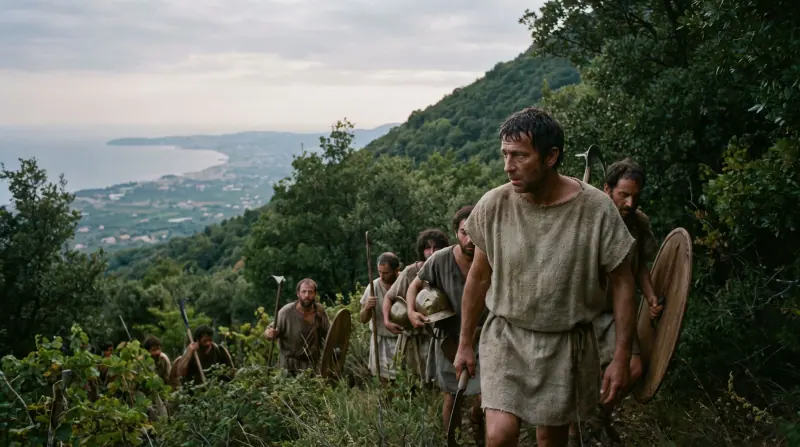
The fugitives took refuge on Mount Vesuvius, then a quiet, vine-covered mountain, long before it buried Pompeii in AD 79. Rome sent about 3,000 hastily raised men under a praetor usually identified as Gaius Claudius Glaber; Plutarch calls him Clodius, and Appian merges him with his successor. Plutarch says Glaber guarded the only path off a steep height. The rebels wove the wild vines on the summit into ladders, climbed down the cliffs where no one was watching, and surprised and took the Roman camp. Florus tells a version with ropes of vine branches. After this victory, Plutarch says, herdsmen and shepherds of the region began to join them.
Evidence: Plutarch · Life of Crassus 8–11 · Appian · Civil Wars 1.116–121 · Velleius Paterculus · Roman History 2.30 · Sallust · Histories, fragments (Latin text) · Florus · Epitome 2.8 (3.20)
Who joined Spartacus, and how large was his army?
The rebels next defeated forces under the praetor Publius Varinius; Plutarch says they captured his lictors and even the horse he rode. Recruits came quickly. Appian says many fugitive slaves and some free men from the countryside joined, and Plutarch describes the herdsmen among them as sturdy and fast on their feet. Rural Italy depended heavily on enslaved labour, so the revolt drew on people with every reason to leave the estates. Sallust and Plutarch mention Gauls and Germans as well as Thracians. Their accounts also show a force that was hard to control: a fragment of Sallust describes followers plundering a settlement in defiance of Spartacus’s orders.
Ancient totals should be read as claims. Florus speaks of more than 10,000 followers early on; Appian gives 70,000 before the consuls took the field in 72 BC, and later 120,000 infantry; Velleius says 90,000 fought in the final battle. The Livian summary claims that 60,000 died with Spartacus. None of these figures can be checked, and they may include non-combatants or simply express alarm. What is clear is that the army fed and armed itself by raiding. Appian says that after taking Thurii, Spartacus barred his men from acquiring gold or silver but bought iron and bronze for weapons.
Evidence: Plutarch · Life of Crassus 8–11 · Appian · Civil Wars 1.116–121 · Sallust · Histories, fragments (Latin text) · Florus · Epitome 2.8 (3.20) · Velleius Paterculus · Roman History 2.30 · Livy · Periochae 96–97
Crixus, the split and the consuls’ defeats in 72 BC
Spartacus was not the only leader. Appian names two other gladiators, Crixus and Oenomaus, as his subordinates; Florus lists the three together. A fragment of Sallust describes Crixus and the Gauls and Germans with him wanting to seek battle while Spartacus argued against it. By 72 BC Crixus led a separate force. Appian says a consul defeated its 30,000 men near Mount Garganus in Apulia, killing Crixus and two-thirds of his force. The Livian summary credits the praetor Quintus Arrius and gives 20,000, while Plutarch has the consul Gellius destroy a German contingent that had broken away. These versions probably describe related events, but they cannot be fully reconciled.
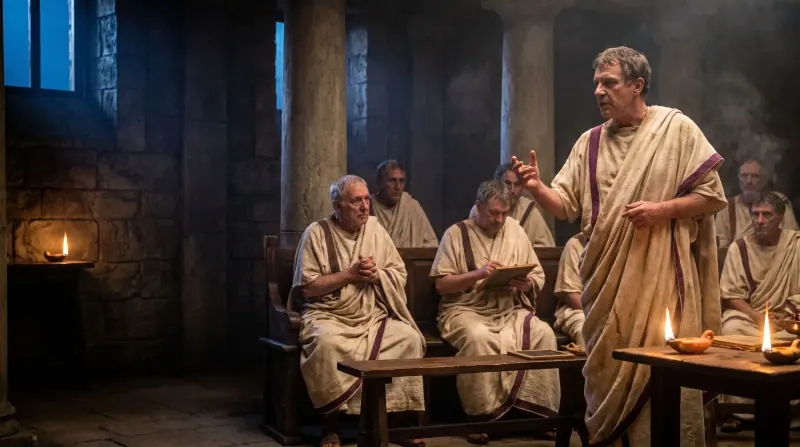
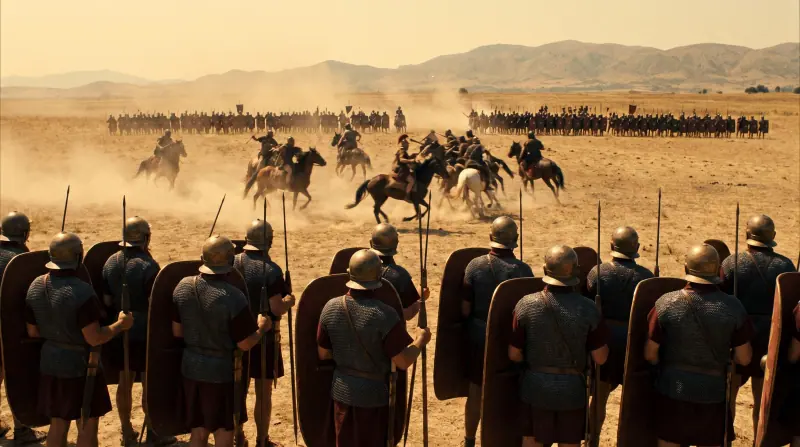
The Senate had sent both consuls of 72 BC, Lucius Gellius Publicola and Gnaeus Cornelius Lentulus Clodianus, because the revolt was now treated as a real war. Spartacus defeated Lentulus and then Gellius. Appian adds that he put three hundred Roman prisoners to death in honour of Crixus. Moving north, he defeated Gaius Cassius, governor of Cisalpine Gaul; Florus places that battle near Mutina, modern Modena. Plutarch says the Senate, angered by these failures, ordered the consuls to stand aside and gave the command to Crassus. Two consular armies had been beaten by a force that began as a few dozen escaped gladiators.
Evidence: Appian · Civil Wars 1.116–121 · Plutarch · Life of Crassus 8–11 · Livy · Periochae 96–97 · Sallust · Histories, fragments (Latin text) · Florus · Epitome 2.8 (3.20)
Did Spartacus try to leave Italy over the Alps?
Plutarch and Appian both say he tried, but they tell the story differently. Plutarch says that after defeating Varinius, Spartacus recognised that he could not overcome Roman power and led his army towards the Alps, so that his followers could cross the mountains and go home, some to Thrace and some to Gaul. Plutarch then has the army pushing towards the Alps again when it defeated Cassius in the north. Appian says Spartacus tried to march through the Apennines to the Alps and the Gallic country, was blocked by the consuls, and beat each of them in turn.
Why the army turned back is disputed. Plutarch blames the followers: confident in their numbers, they refused to leave and went on raiding Italy. A damaged fragment of Sallust appears to describe a similar argument, with only a minority in favour of escape. Appian instead has Spartacus march on Rome with 120,000 men and then abandon the plan because his force was not ready; Florus also mentions a plan to attack Rome. Modern historians suggest further reasons, including Roman forces in the north, the difficulty of the passes, and followers born in Italy with no home beyond the Alps. These remain inferences.
Evidence: Plutarch · Life of Crassus 8–11 · Appian · Civil Wars 1.116–121 · Sallust · Histories, fragments (Latin text) · Florus · Epitome 2.8 (3.20)
Crassus’s command: decimation, the pirates and the wall
Marcus Licinius Crassus, one of the richest men in Rome, took over late in 72 BC; Appian says he raised six new legions and also received the consuls’ two. Plutarch says his legate Mummius disobeyed orders, attacked and was routed. Crassus then revived decimation, an old military punishment: Plutarch reports that five hundred men who had fled first were divided into groups of ten, and one man from each group, chosen by lot, was put to death. Appian records two versions, one in which the consular legions were decimated and another, introduced with “some say”, in which about 4,000 men were killed.
Spartacus retreated south to the Strait of Messina. Plutarch says he agreed with Cilician pirates to carry 2,000 men to Sicily, where he hoped to revive the slave wars the island had seen in earlier decades; the pirates took his gifts and sailed away. Florus adds a failed attempt to cross on rafts. Crassus then cut off the toe of Italy with a ditch and wall from sea to sea. Plutarch claims it ran three hundred stades, roughly 55 kilometres, with a ditch fifteen feet wide and deep. On a snowy winter night Spartacus filled part of the ditch and broke out.
Evidence: Plutarch · Life of Crassus 8–11 · Appian · Civil Wars 1.116–121 · Florus · Epitome 2.8 (3.20) · Livy · Periochae 96–97
How did Spartacus die? The final battle and the Appian Way
In 71 BC the rebels divided again. Crassus destroyed a separate group led by Gannicus and Castus; the Livian summary claims 35,000 dead. Rome had also summoned Pompey’s army from Spain, and Appian says news that another Roman army had landed at Brundisium made Spartacus despair of escape. He had earlier offered terms, which Crassus refused. The last battle was fought somewhere in southern Italy; the exact site is unknown. Plutarch says Spartacus tried to fight his way to Crassus himself and was cut down. Appian says he was wounded in the thigh, fought on until he was killed, and that his body was never found.
Many survivors escaped into the mountains. Appian says they were hunted down and that about 6,000 who were captured were crucified along the whole road from Capua to Rome, the Appian Way. Crucifixion was Rome’s customary punishment for enslaved rebels, carried out in public as a warning. The figure comes from Appian, writing more than two centuries later. Plutarch adds that Pompey, arriving from Spain, intercepted about 5,000 fugitives from the battle. The places mattered: the punishment stretched from the city where the revolt began to the capital itself.
Evidence: Plutarch · Life of Crassus 8–11 · Appian · Civil Wars 1.116–121 · Plutarch · Life of Pompey 21–22 · Florus · Epitome 2.8 (3.20) · Livy · Periochae 96–97
Who got the credit: Crassus, Pompey and the consulship of 70 BC
Crassus had won the war, but Pompey claimed part of the glory. Plutarch says Pompey wrote to the Senate that Crassus had defeated the slaves in battle while he himself had pulled the war up by the roots. Pompey celebrated a full triumph for his victories in Spain. Crassus, Plutarch says, did not venture to ask for a full triumph over slaves, and celebrated the lesser honour of an ovation. Velleius, writing about AD 30, nevertheless gives Crassus the glory of ending the war, and Appian says he finished it within six months.
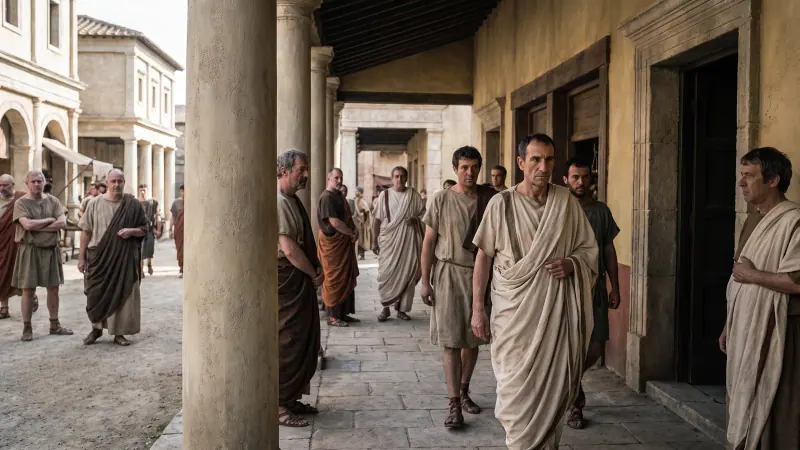
Both men kept their armies near Rome and stood for the consulship of 70 BC. Pompey had held none of the usual offices; the Livian summary says a special decree of the Senate allowed his candidacy. As consuls they quarrelled, according to Plutarch and Appian, but they restored the tribunes’ powers that Sulla had cut back, and staged a public reconciliation. Their rivalry and occasional cooperation shaped the next two decades, through their later alliance with Julius Caesar, Crassus’s death in 53 BC, and the civil war that began with Caesar’s march on Rome in 49 BC.
Evidence: Plutarch · Life of Crassus 8–11 · Plutarch · Life of Pompey 21–22 · Appian · Civil Wars 1.116–121 · Velleius Paterculus · Roman History 2.30 · Livy · Periochae 96–97
Did Spartacus want to end slavery?
No ancient source says so. Appian describes the original escape as a fight for the gladiators’ own freedom, and Plutarch’s Spartacus wants his followers to go home. Enslaved people who joined the army escaped their owners, but no plan to end slavery in Italy is recorded, and ancient critics of slavery rarely, if ever, proposed abolishing it. Florus even claims that Spartacus held funerals for fallen officers at which Roman captives were made to fight as gladiators, turning a Roman custom against Romans. That suggests a man using the world he knew rather than rejecting it. His aims beyond freedom, survival and escape are unknown.
The liberator of all slaves is largely a modern figure. Karl Marx, writing to Friedrich Engels in 1861 after reading Appian, admired Spartacus as a great general and a representative of the ancient proletariat. German revolutionaries around Rosa Luxemburg and Karl Liebknecht called themselves the Spartacus League. Howard Fast’s 1951 novel became Stanley Kubrick’s 1960 film starring Kirk Douglas, and a Starz television series of 2010–2013 found a new audience. The famous “I’m Spartacus” scene, in which captives shield their leader, is fiction, and so is the film’s ending on a cross. The sources say he died in battle.
Evidence: Appian · Civil Wars 1.116–121 · Plutarch · Life of Crassus 8–11 · Florus · Epitome 2.8 (3.20) · Sallust · Histories, fragments (Latin text)
Timeline
- 73 BC
Gladiators escape from Lentulus Batiatus’s school at Capua and take refuge on Mount Vesuvius.
- Later in 73 BC
The rebels slip past Glaber’s blockade, overrun his camp, and then defeat the praetor Publius Varinius.
- 72 BC
Crixus’s separate force is destroyed in Apulia; Spartacus defeats both consuls in turn.
- 72 BC, in the north
Spartacus defeats Gaius Cassius near Mutina, modern Modena, and then turns back south.
- Late 72 BC
The Senate gives the war to Crassus, who punishes a defeated unit by decimation.
- Winter 72–71 BC
Pirates fail to carry rebels to Sicily; Crassus walls off the toe of Italy, but Spartacus breaks out.
- 71 BC
Crassus defeats the rebels and Spartacus is killed; Appian reports 6,000 captives crucified along the Appian Way.
- 70 BC
Crassus and Pompey hold the consulship together and restore the powers of the tribunes.
Questions people ask
Was Spartacus a real person?
Yes. Several ancient writers, including Sallust, Velleius Paterculus, Plutarch, Appian and Florus, describe him and the war of 73–71 BC. His early life and the size of his army are uncertain, but his existence and the revolt are not in doubt.
Where did the Spartacus revolt start?
At a gladiatorial school owned by Lentulus Batiatus in Capua, in Campania, in 73 BC. The escaped gladiators first took refuge on Mount Vesuvius.
How did Spartacus die?
He was killed in the final battle against Crassus in southern Italy in 71 BC. Plutarch says he was cut down trying to reach Crassus; Appian says he was wounded in the thigh, fought on and was killed, and that his body was never found. He was not crucified.
How many slaves were crucified after the Spartacus revolt?
Appian reports that about 6,000 captured survivors were crucified along the road from Capua to Rome, the Appian Way. The number comes from Appian, writing more than two centuries later, and should be treated as his figure.
Did Spartacus try to escape over the Alps?
Plutarch and Appian say he led his army north towards the Alps, and he defeated a Roman army near Mutina in northern Italy. The army then turned back. Plutarch blames followers who preferred raiding Italy; Appian says Spartacus considered marching on Rome. The real reason is unknown.
Who defeated Spartacus?
Marcus Licinius Crassus commanded the Roman forces that defeated him in 71 BC. Pompey, returning from Spain, destroyed fugitives from the battle and claimed a share of the credit, which fed the rivalry between the two men.
Did Spartacus want to abolish slavery?
There is no evidence that he did. The sources present the revolt as a fight for the rebels’ own freedom, survival and escape. The image of Spartacus as an opponent of slavery itself comes mainly from modern politics and fiction.
Did “I’m Spartacus” really happen?
No. The scene was created for Stanley Kubrick’s 1960 film. No ancient source describes captives claiming to be Spartacus; Appian says his body was not found after the final battle.
Sources and perspective
Sources are identified beside the sections they support. Ancient and medieval authors wrote from particular positions; a detailed story can still be partisan, late or uncertain. Archaeology can test an account without confirming every detail.
- Plutarch · Life of Crassus 8–11
The fullest narrative, written in the early second century AD, more than a century and a half after the war. It includes the vine ladders, decimation, the pirates and the wall; numbers and anecdotes need caution.
- Appian · Civil Wars 1.116–121
A compressed Greek narrative from the mid-second century AD and the source for the 6,000 crucifixions and the missing body. Its chronology and army totals are sometimes confused.
- Sallust · Histories, fragments (Latin text)
Written in the 30s BC, within a generation of the revolt, and widely thought to lie behind parts of Plutarch and Appian. Only scattered fragments survive, some restored by editors; this page gives the Latin without translation.
- Velleius Paterculus · Roman History 2.30
A brief notice written about AD 30, earlier than Plutarch and Appian. It gives its own figures for the escape and the final battle and credits Crassus with ending the war.
- Florus · Epitome 2.8 (3.20)
A rhetorical second-century summary, openly contemptuous of the rebels. Useful for details such as the vine ropes, Mutina and the rafts, but not a careful narrative.
- Livy · Periochae 96–97
Late ancient summaries of Livy’s lost books. They preserve names and outcomes for 72–71 BC and the consulship of 70 BC, with casualty figures that cannot be checked.
- Plutarch · Life of Pompey 21–22
Pompey’s claim to have finished the war, his triumph and his consulship with Crassus, told by the same biographer long after the events.
Published . Updated . Research, authorship and corrections.
Report a historical correctionKeep your place in history.
Reading progress stays in this browser, on this device.
Choose your next episode