Why Caesar and Pompey fought in Greece
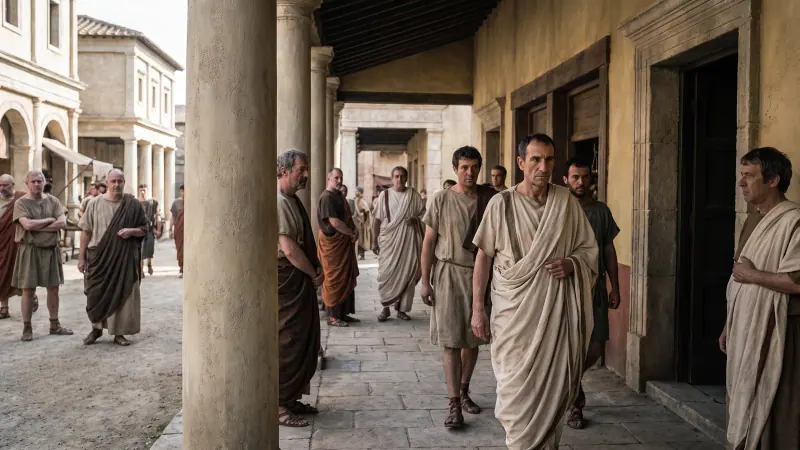
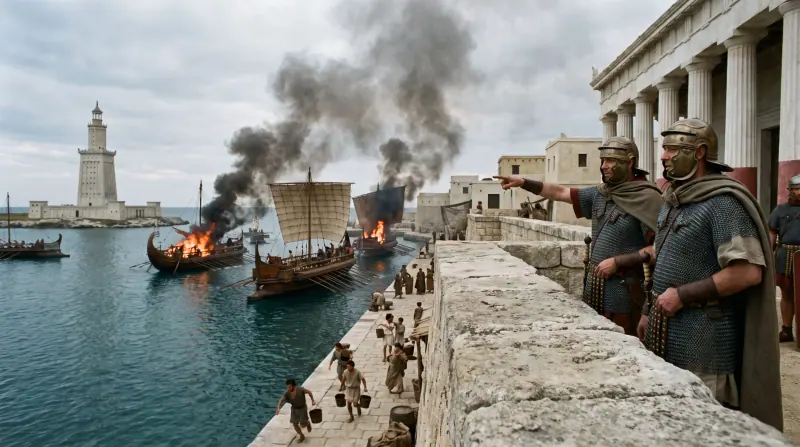
The civil war that began in 49 BC did not remain in Italy. Pompey withdrew east, where he could gather troops, money and support from provinces and allied rulers. After securing his position in the west, Caesar crossed the Adriatic in 48 BC. His campaign depended on moving reinforcements and supplies across waters in which Pompey’s naval forces were a serious obstacle.
At Dyrrachium Caesar attempted to contain Pompey but suffered a damaging reverse. He then marched into Thessaly, seeking food and a more favourable opportunity. Pharsalus followed this setback, not an uninterrupted series of easy victories. Caesar’s account stresses how he restored confidence before testing whether Pompey would accept battle.
Evidence: Caesar · Civil War 3.1–30 · Caesar · Civil War 3.82–112 · Cassius Dio · Roman History 41.47–63
The commanders, armies and uncertain numbers
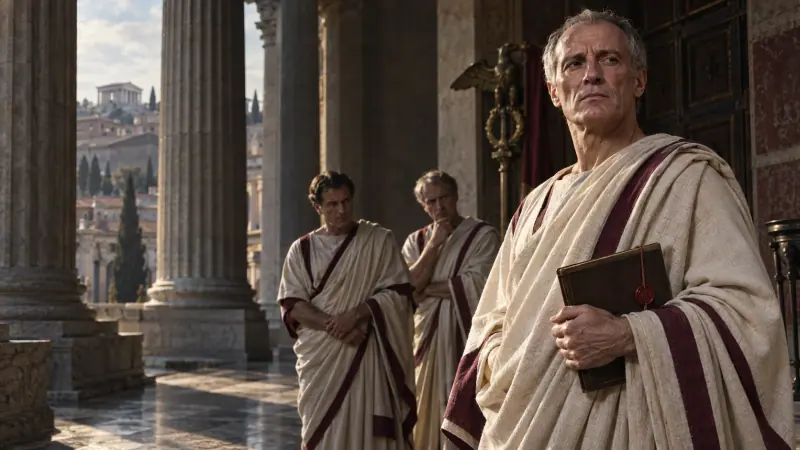
Caesar and Pompey were former political partners and now rival Roman commanders. Their forces were not neatly divided into “Rome” and a foreign enemy. Both armies included Roman soldiers, and Pompey’s coalition also drew on many eastern allies. Titus Labienus, once a leading lieutenant in Caesar’s Gallic campaigns, now fought on Pompey’s side.
Caesar gives himself approximately 22,000 infantry and 1,000 cavalry, against 45,000 infantry and 7,000 cavalry for Pompey. These figures belong to the victorious commander’s narrative and should not be treated as independently checked totals. His smaller veteran force and Pompey’s much greater cavalry strength are essential to his explanation of the battle.
Evidence: Caesar · Civil War 3.82–112 · Plutarch · Life of Caesar 39–49
Where was Pharsalus, and why did Pompey accept battle?
The encounter took place in Thessaly, in the region of ancient Pharsalus and Palaepharsalus. Modern reconstructions differ over the precise site and how the ancient descriptions fit the rivers and hills. A useful explanation can show the opposing flanks and the reserve manoeuvre without pretending that every position has a settled modern coordinate.
Caesar portrays Pompey’s officers as overconfident after Dyrrachium and already disputing the rewards of victory. Later writers also emphasize pressure on Pompey to fight rather than continue wearing Caesar down. These accounts are shaped by knowledge of the result. Accepting battle was a decision made with a larger army and an apparent cavalry advantage, not necessarily an inexplicable rejection of an effortless alternative.
Evidence: Caesar · Civil War 3.82–112 · Cassius Dio · Roman History 41.47–63
Pompey’s cavalry plan and Caesar’s fourth line
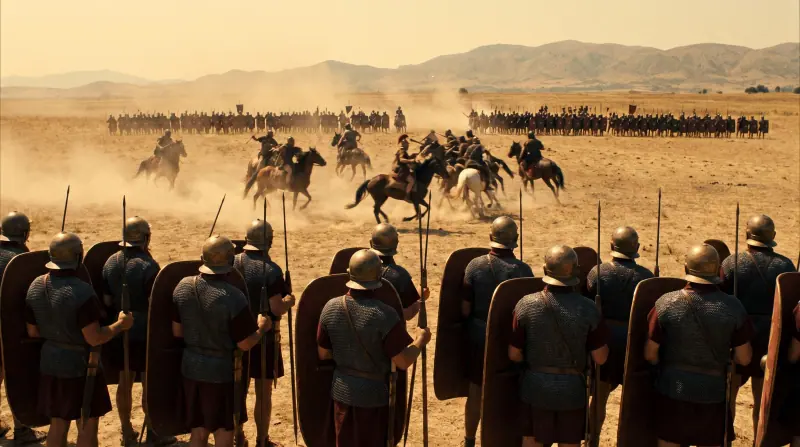
Pompey massed cavalry on his left, opposite Caesar’s right. The plan was to drive away Caesar’s smaller mounted force and sweep around the infantry flank. His main infantry line was instructed to receive the enemy’s advance rather than rush forward. Caesar criticized that decision, but his criticism is part of a victor’s account of the opposing commander.
Anticipating the flank attack, Caesar detached cohorts from his third infantry line and placed an additional line to support the threatened wing. He describes six cohorts taking part in the counterattack. This fourth line was a specific response to Pompey’s cavalry advantage, not a separate full army hidden beyond the battlefield.
Evidence: Caesar · Civil War 3.82–112
The sequence of the battle
Caesar’s infantry advanced, paused when Pompey’s line remained stationary, and then renewed the attack. The halt was intended to avoid reaching the enemy exhausted by an unnecessarily long run. While the infantry fought, Pompey’s cavalry pushed back Caesar’s horsemen and began the turning movement on the Roman right.
Caesar gave the signal to the waiting cohorts. Their attack drove the cavalry away, leaving Pompey’s archers and slingers exposed. The cohorts then moved onto the unprotected infantry flank. Caesar also committed the fresh troops of his third line to the main struggle. A failed cavalry manoeuvre became a wider collapse through the combination of flank pressure and renewed frontal attack.
Pharsalus: how the reserve changed the battle
Schematic sequence after Caesar, Civil War 3.88–94. Gold represents Caesar’s army; red represents Pompey’s. Both sides include Roman troops. Shapes distinguish infantry, cavalry and reserve; they do not show exact troop numbers or a settled battlefield location.
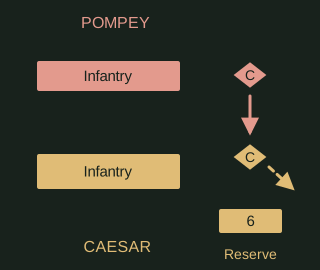
1. Pompey attacks the flank
Pompey’s larger cavalry force pushes back Caesar’s horsemen and attempts to turn his right flank. Caesar has prepared a fourth line for this threat.
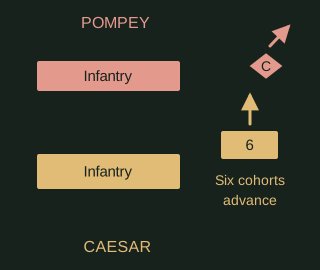
2. The reserve counters
Caesar signals the six cohorts to attack. The cavalry retreats, leaving Pompey’s archers, slingers and infantry flank exposed.
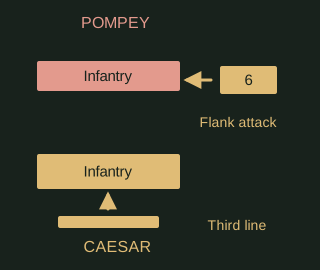
3. Pressure from two directions
The reserve turns against Pompey’s infantry while Caesar commits his fresh third line. The frontal struggle becomes an attack on the flank and rear as well.
Evidence: Caesar · Civil War 3.82–112
Did Caesar order his men to strike the riders’ faces?
Plutarch’s later Life of Caesar says the cohorts used their javelins to thrust at the cavalrymen’s faces, exploiting the supposed fear of disfigurement among inexperienced young aristocrats. It is one of the battle’s most memorable stories, but Caesar’s own explanation does not make this psychology the cause of victory.
The existence and role of the reserve are much better grounded than an assertion that all Pompeian horsemen were vain youths who fled to protect their looks. The anecdote tells us something about the moralizing and character-driven style of later biography. It should be presented as an attributed tradition, not the single proven secret of Pharsalus.
Evidence: Plutarch · Life of Caesar 39–49 · Caesar · Civil War 3.82–112
Casualties, surrender and Pompey’s death
Caesar’s men captured Pompey’s camp and pursued retreating troops. Caesar reports about 15,000 enemy dead and more than 24,000 prisoners, while claiming losses of approximately 200 of his own soldiers and about thirty centurions. The extreme imbalance and the author’s interest in magnifying his success demand caution. We can identify a decisive defeat without accepting these figures as a precise census.
Pompey escaped and eventually sought refuge in Egypt, where members of Ptolemy XIII’s court arranged his murder. Caesar did not kill him in battle at Pharsalus. The pursuit brought Caesar into the struggle involving Cleopatra’s return to power and the Alexandrian War, connecting a Roman civil war with an Egyptian dynastic conflict.
Evidence: Caesar · Civil War 3.82–112 · Plutarch · Life of Caesar 39–49
Why Pharsalus did not end the civil war
The battle removed Pompey as Caesar’s main military rival, but his cause and supporters were not concentrated in one person or one camp. Caesar still faced campaigns in Egypt, Africa and Spain. Major victories at Thapsus in 46 BC and Munda in 45 BC belonged to the continuing struggle, not to a peace established at Pharsalus.
The victory accelerated the concentration of authority that led toward Caesar’s dictatorship for life. It did not automatically turn the Republic into a settled monarchy. Tactically, the battle rewards attention to reserves and timing; politically, it continues the problem already visible during Caesar’s return to Rome: military success could defeat opponents without creating lasting agreement about legitimate government.
Evidence: Caesar · Civil War 3.82–112 · Suetonius · Julius Caesar 35–39
Timeline
- 49 BC
Caesar enters Italy; Pompey withdraws east, while Caesar campaigns against his forces in Spain.
- Early 48 BC
Caesar crosses the Adriatic; Antony later brings reinforcements.
- Summer 48 BC
Caesar suffers a reverse around Dyrrachium and withdraws into Thessaly.
- Before Pharsalus
The armies confront one another; Pompey concentrates cavalry on his left.
- Battle of Pharsalus
Caesar’s infantry reserve defeats the cavalry attack, turns onto the enemy flank, and helps break the line.
- After the battle
Caesar pursues and accepts surrenders; Pompey escapes by sea.
- Later in 48 BC
Pompey is murdered in Egypt; Caesar arrives and becomes involved in the Alexandrian conflict.
- 46–45 BC
Further major fighting against Caesar’s opponents takes place in Africa and Spain.
Questions people ask
Who won the Battle of Pharsalus?
Julius Caesar defeated Pompey the Great in Thessaly in 48 BC. Pompey escaped but was murdered later that year in Egypt.
Why did Pompey lose at Pharsalus?
Caesar anticipated Pompey’s cavalry attack and used an infantry reserve to repel it. The reserve then attacked the exposed flank while fresh infantry joined the main battle.
What was Caesar’s fourth line?
It was a reserve formed from cohorts detached from his third line and positioned to counter the enemy cavalry. Caesar identifies six cohorts in the decisive counterattack.
How many soldiers fought at Pharsalus?
Caesar reports roughly 22,000 infantry and 1,000 cavalry on his side, against 45,000 infantry and 7,000 cavalry under Pompey. These are partisan ancient estimates, not confirmed modern totals.
Was Pompey killed at Pharsalus?
No. He escaped the battlefield and later sailed to Egypt, where he was assassinated on the orders of members of the royal court.
Did Pharsalus end Rome’s civil war?
No. Caesar still fought in Egypt, Africa and Spain. Defeating Pompey did not eliminate all the armies and political groups resisting him.
Sources and perspective
Sources are identified beside the sections they support. Ancient and medieval authors wrote from particular positions; a detailed story can still be partisan, late or uncertain. Archaeology can test an account without confirming every detail.
- Caesar · Civil War 3.1–30
The Adriatic crossing and early campaign, narrated by Caesar himself and framed around his difficulties and initiative.
- Caesar · Civil War 3.82–112
The central account of dispositions, reserve, battle, prisoners and pursuit. Army sizes, losses and enemy motives are particularly vulnerable to partisan presentation.
- Plutarch · Life of Caesar 39–49
A later biography, including the faces anecdote. Dramatic character explanations should be distinguished from Caesar’s own tactical narrative.
- Cassius Dio · Roman History 41.47–63
A later interpretation of Dyrrachium, the decision to fight and the battle; speeches and private deliberations are reconstructed.
- Suetonius · Julius Caesar 35–39
A compressed account of Caesar’s subsequent campaigns and triumphs, useful for distinguishing victory at Pharsalus from the end of the war.
Published . Updated . Research, authorship and corrections.
Report a historical correctionKeep your place in history.
Reading progress stays in this browser, on this device.
Choose your next episode