Why was Caesar in Egypt?
Caesar reached Egypt while pursuing Pompey after Pharsalus in 48 BC. Advisers to Ptolemy XIII had arranged Pompey’s murder before Caesar arrived. Egypt was simultaneously in a civil conflict of its own: Ptolemy’s faction had expelled his sister and co-ruler Cleopatra, who was raising forces to reclaim her position.
Caesar claimed authority to arbitrate under the will of their father, Ptolemy XII, and Egypt’s ties to Rome. He also sought money owed by the dynasty. Cleopatra’s return to Alexandria gave her access to him, but his proposed joint settlement angered opponents of Roman interference. Achillas marched the royal army into the city, turning diplomacy backed by a small expeditionary force into a struggle for survival.
Evidence: Caesar · Civil War 3.103–112 · Plutarch · Life of Caesar 48–49
Who fought, and why did Alexandria’s geography matter?
Caesar’s troops held a limited area around the palace, not all Alexandria. The city’s sea frontage, harbors, island of Pharos and connecting causeway offered routes for supplies and reinforcements but also narrow points an enemy could threaten. Dense buildings and barricaded streets made movement between positions difficult. Securing a landing place could matter as much as winning an open fight.
The defenders of the city were capable opponents with workshops, naval experience and access to the surrounding kingdom. Their leadership also changed. Arsinoe, Cleopatra’s sister, joined the resistance; her associate Ganymedes displaced Achillas after a lethal factional struggle. The anonymous Alexandrian War praises Roman ingenuity while repeatedly insulting Alexandrian character. Its operational detail is valuable, but those ethnic judgments are the author’s prejudice, not an explanation of Egyptian behavior.
Evidence: Caesar · Civil War 3.103–112 · Alexandrian War 1–33
How did Caesar survive the water crisis?
Alexandria depended on channels and cisterns carrying Nile water. According to the Alexandrian War, Ganymedes blocked channels in the area he controlled and pumped seawater toward Caesar’s sector. The increasingly salty supply frightened soldiers who already feared being trapped between hostile streets and the sea. Leaving their defenses to embark could expose them to attack before they reached the ships.
Caesar ordered his men to dig wells, and the account says fresh water was found during the night. This resolved the immediate emergency, while continuing naval access remained essential for supplies. The episode explains why a siege is not simply a contest of walls: water, engineering, local knowledge and confidence can determine whether an army holds its position.
Evidence: Alexandrian War 1–33
The harbor battles and Caesar’s escape at Pharos
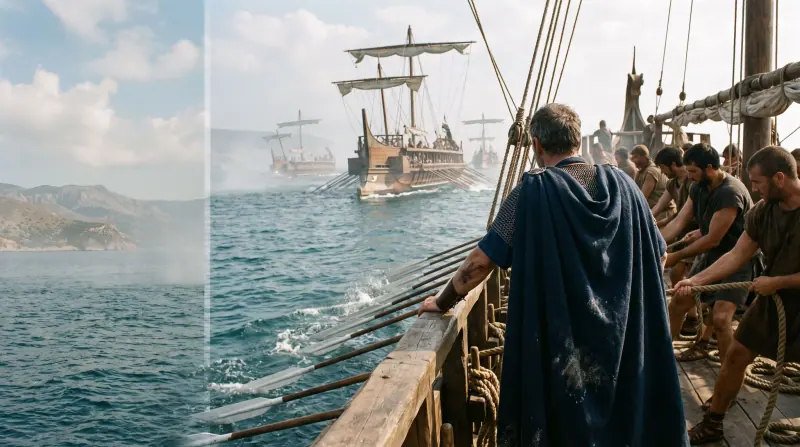
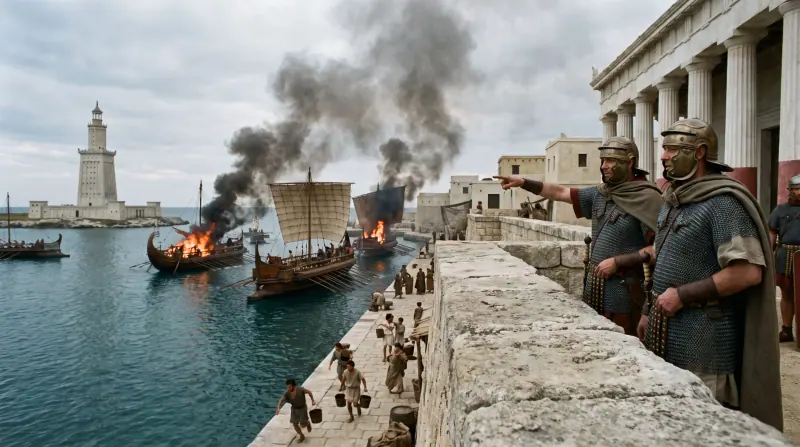
At the start of the fighting Caesar burned ships he could not safely secure, aiming to prevent their use against his communications. The Alexandrians built and repaired further vessels, and repeated engagements followed. Caesar relied heavily on allied crews, particularly the Rhodians under Euphranor. Narrow channels and shallow water constrained deployment, making coordination and seamanship critical.
Roman troops captured Pharos, but an attempt to secure a further bridge on the causeway ended badly. The Alexandrian War describes men landing without proper order, a counterattack, confusion behind the Roman position and a rush toward the boats. Caesar’s vessel became overcrowded and he escaped by swimming to ships farther away. The source admits hundreds of Roman soldiers and sailors were lost, a useful correction to any picture of effortless victory.
Ptolemy XIII was eventually released from Caesar’s custody after an appeal that his presence could help end the war. Instead he took command against Caesar. The pro-Caesarian author presents even this reversal as compatible with Caesar’s foresight. That defense of the commander should be separated from the observable sequence: the king went over to the opposing army and fighting continued.
Evidence: Caesar · Civil War 3.103–112 · Alexandrian War 1–33
Did Caesar burn the Library of Alexandria?
A harbor fire during Caesar’s operations is well attested, but what it destroyed is much less clear. Caesar reports burning ships without describing the destruction of the great library. Plutarch later says the fire spread and destroyed the library. Cassius Dio also reports the loss of a collection of books amid fires at the docks and grain stores. These later narratives do not establish exactly which buildings and collections were affected.
The safe conclusion is that the fighting caused fire and damage, and that ancient writers associated it with the loss of books. The number of books, their precise storage location and the fate of the major library institution cannot be established from these accounts alone. A single image of all ancient learning disappearing in Caesar’s fire gives a misleading certainty to a disputed history.
Evidence: Caesar · Civil War 3.103–112 · Plutarch · Life of Caesar 48–49 · Cassius Dio · Roman History 42.34–43
How did the war end?
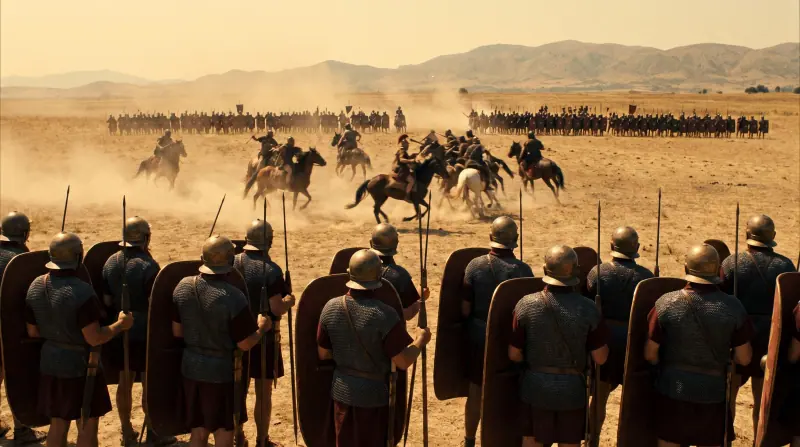
The decisive change came from outside Alexandria. Mithridates of Pergamum gathered allied forces in Syria and Cilicia, entered Egypt through Pelusium and advanced toward the Nile. Ptolemy moved to stop him. Caesar then left his confined position to unite with the relief army, transforming the balance of forces.
In the resulting campaign Caesar defeated the royal army and stormed its camp. The Alexandrian War reports that Ptolemy died when a crowded vessel carrying him sank during the retreat. Alexandria submitted. Caesar confirmed Cleopatra as ruler alongside her younger brother Ptolemy XIV; Arsinoe was taken away as a captive. The presence of Roman troops made the new settlement enforceable.
Evidence: Alexandrian War 1–33
Why the Alexandrian War mattered
The war secured Cleopatra’s restoration and demonstrated how Egyptian succession politics had become tied to Roman military power. It also consumed time while Caesar’s wider civil war remained unfinished. His survival in Egypt was a stage on the road to his later dictatorship for life, not the end of his campaigns.
Egypt was not annexed in 47 BC. Cleopatra continued to rule, later allied with Antony, and lost her kingdom only after Actium and the conquest of 30 BC. Separating these wars matters: Caesar’s siege restored a monarch, while Octavian’s later conquest ended the dynasty’s independent rule.
Evidence: Alexandrian War 1–33 · Plutarch · Life of Antony 61–87
Timeline
- 48 BC
Pompey flees Pharsalus and is murdered on reaching Egypt.
- 48 BC
Caesar arrives and intervenes in the royal succession.
- 48 BC
Achillas brings the royal army against Caesar’s position in Alexandria.
- During the siege
Ships are burned; control of the harbor and Pharos becomes crucial.
- During the siege
Ganymedes threatens the Roman water supply; Caesar’s men dig wells.
- During the siege
Caesar suffers a reverse at a bridge near Pharos and escapes by swimming.
- 47 BC
Mithridates of Pergamum’s relief army enters Egypt; Caesar joins it.
- 47 BC
Ptolemy’s army is defeated, the king dies and Cleopatra’s rule is secured.
Questions people ask
Who won the Alexandrian War?
Caesar and his allies won in 47 BC after the arrival of reinforcements under Mithridates of Pergamum. Cleopatra was restored and Ptolemy XIII died following his army’s defeat.
Was Caesar besieging Alexandria or besieged inside it?
For much of the war Caesar held a limited palace and harbor sector inside a hostile city. He defended that position while conducting attacks to secure water, communications and harbor access.
Did Cleopatra fight Caesar in the Alexandrian War?
No. She relied on his support. Ptolemy XIII’s forces opposed Caesar, and her sister Arsinoe became another rival claimant within the resistance.
Did Julius Caesar really swim to safety?
The near-contemporary Alexandrian War describes him leaving an overloaded vessel and swimming to other ships after the bridge operation failed. Later biographies add more dramatic details.
Was all of the Library of Alexandria destroyed in 48 BC?
That cannot be established. Ancient accounts disagree about the fire’s victims and the location of the books. Damage to books or warehouses does not prove that the entire library institution disappeared then.
Is the Battle of the Nile the same as the Alexandrian War?
The land fighting near the Nile was the decisive closing campaign within the broader Alexandrian War. The conflict also included months of urban siege and naval operations.
Sources and perspective
Sources are identified beside the sections they support. Ancient and medieval authors wrote from particular positions; a detailed story can still be partisan, late or uncertain. Archaeology can test an account without confirming every detail.
- Caesar · Civil War 3.103–112
Caesar’s explanation of his intervention and the opening fighting; self-justification shapes the narrative.
- Alexandrian War 1–33
Detailed near-contemporary military account of uncertain authorship; openly pro-Caesarian and hostile toward Alexandrians.
- Plutarch · Life of Caesar 48–49
Later account connecting the harbor fire to the great library; should be compared with the other fire narratives.
- Cassius Dio · Roman History 42.34–43
Later narrative describing stores and books lost to fire; does not settle the extent of damage to the library.
- Plutarch · Life of Antony 61–87
Context for the much later war that ended Cleopatra’s reign; its events should not be merged into Caesar’s siege.
Published . Updated . Research, authorship and corrections.
Report a historical correctionKeep your place in history.
Reading progress stays in this browser, on this device.
Choose your next episode