The death of Cleopatra and the fall of Ptolemaic Egypt
Cleopatra VII died in Alexandria in August 30 BC after Octavian conquered Egypt and Mark Antony died. Her death is generally understood as suicide, but the famous snakebite is one ancient tradition among conflicting accounts, not a securely established medical finding. The conquest ended the independence of the Ptolemaic monarchy. Egypt became a Roman province while its people, institutions and religious traditions continued under a new imperial ruler.
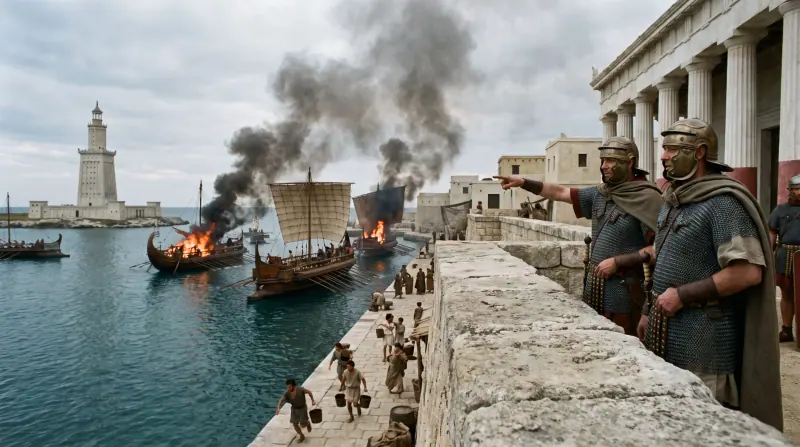
Alexandria, 30 BC. After defeat at Actium, Antony and Cleopatra can no longer hold their coalition together. Octavian's forces advance into Egypt and take the capital. Antony dies, and Cleopatra is left under the victor's control. In August, she too is dead. The last reigning Ptolemaic queen leaves behind a kingdom facing a new master. Egypt becomes a Roman province, its wealth and grain supporting Octavian's power. Temples, communities and older traditions endure, but the dynasty that ruled from Alexandria has fallen. Rome's long civil struggle has delivered Egypt to its victor.
Sources and context +
The historical guide below follows the people, events and surviving accounts behind this episode. Explore the sources.
Inside the episode
Cinematic scenes
Look closer at the individual moments within this story.
August 30 BC
The death of Cleopatra
Cleopatra’s death closes her reign as Egypt passes under Octavian’s rule.
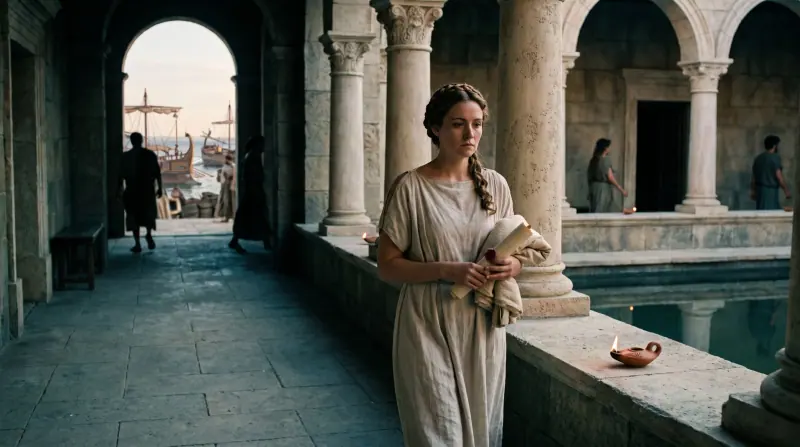
Alexandria, August 30 BC. Octavian has conquered Egypt, and Antony is dead. Cleopatra, the last reigning Ptolemaic queen, remains under the victor's control. Her reign has survived exile, a struggle against her brother and years of alliances with Rome's most powerful men. Now the kingdom she fought to preserve has fallen. Cleopatra takes her own life, bringing her rule to an end. Egypt becomes a Roman province, and its wealth strengthens Octavian's command of the Mediterranean. Beyond the palace, the people of Egypt continue their lives beneath a new imperial authority.
Sources and context +
Cleopatra died in Alexandria after Octavian’s conquest and Antony’s death. Ancient sources generally describe suicide but disagree about its mechanism; the famous snakebite is not securely established. The chamber, final movements and expressions are imagined, and no method is shown.
The historical guide below follows the people, events and surviving accounts behind this episode. Explore the sources.
The event at a glance
The essentials.
Date
August 30 BC; the exact day of Cleopatra’s death is not secure
Place
Alexandria, Egypt
Conqueror
Octavian, later known as Augustus
Cleopatra’s age
39, according to Plutarch
Outcome
Ptolemaic rule ends and Roman provincial government begins
01
Why did Cleopatra’s kingdom collapse?
Cleopatra had sustained Egypt’s position through alliances with dominant Romans, first Caesar and later Antony. Her return to power in 48–47 BC had succeeded because Caesar’s intervention overturned a hostile royal faction. Two decades later the same dependence on a Roman partner exposed the kingdom when that partner lost.
Defeat at Actium in 31 BC did not instantly destroy every military resource, but it undermined Antony’s credibility and prompted defections. He and Cleopatra returned to Egypt without rebuilding a coalition capable of matching Octavian. Ancient accounts describe further preparations, diplomatic approaches and efforts to preserve the children’s prospects. These show a court seeking options, rather than one uninterrupted scene of romantic despair.
Octavian wanted to eliminate a rival center of power and secure the resources of Egypt. His relationship to Cleopatra was therefore unlike Caesar’s earlier arbitration. Restoring a friendly Ptolemaic ruler was no longer necessary to resolve a succession dispute: he could place the kingdom under his own authority.
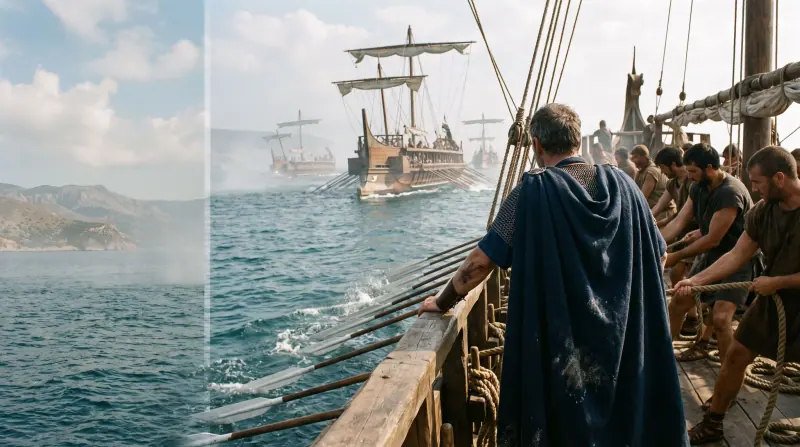
The campaign approached Egypt through both its eastern and western connections. Pelusium, controlling the eastern route, fell, and Antony’s efforts to resist near Alexandria did not reverse the wider military collapse. Plutarch describes a final day when Antony expected his fleet to attack but instead watched its crews change sides. Cavalry also deserted, leaving his infantry unable to sustain the contest.
Dio assigns Cleopatra secret responsibility for several failures. Such accusations fit his recurring picture of a manipulative queen and should not be accepted as transparent access to her plans. The stronger conclusion is that military loyalty was disintegrating and Octavian’s force prevailed. The exact mixture of betrayal, negotiated submission and overwhelming pressure cannot be reconstructed from hostile literary accounts alone.
Antony died in Alexandria after the final defeat. Plutarch tells a dramatic sequence in which Cleopatra takes refuge in her mausoleum, Antony receives a false report of her death, wounds himself and is carried to her before dying. Dio gives a related but differently motivated version. Both wrote much later than the events.
The broad outcome is clear; the private dialogue and every movement inside the palace and mausoleum are not. Antony’s death removed Octavian’s principal Roman opponent. It also left Cleopatra confronting the victor without the military and political partner on whom her final resistance had depended. Calling it merely the ending of a love story overlooks that collapse of government and protection.
The accounts agree that Octavian wanted Cleopatra alive, in part for display in a Roman triumph. Plutarch describes her capture, discussions about her possessions and concern for her children. He presents the prospect of humiliation in Rome as central to her decision to die. This is a plausible political context, although her last thoughts cannot be independently recovered.
She was a defeated sovereign under another ruler’s control, not a queen freely choosing between equally viable diplomatic offers. Ancient authors frame her death using themes of courage, deception, dignity and gender. Their judgments tell us how later writers interpreted her conduct. They do not make her death a necessary or universal response to defeat, and they should not erase the lives of attendants and family members caught in the same crisis.
A snake is the most famous explanation, but Plutarch explicitly admits uncertainty. He records different versions of a concealed snake and an alternative involving poison. He also says no snake was found in the room. Suetonius describes a report of snakebite and Octavian’s attempt to keep Cleopatra alive; Dio likewise preserves competing explanations.
The sources therefore support an ancient tradition of suicide while leaving the mechanism unresolved. “Asp” in these narratives should not be treated as a laboratory identification of a species. The often illustrated Egyptian cobra is a reconstruction of the story, not a specimen recovered from the scene. Nor can modern certainty be created merely by choosing a more medically plausible alternative.
Plutarch names the attendants Iras and Charmion in the account of the final chamber and describes their deaths as well. Their exact speech and actions belong to his literary narrative. An image of Cleopatra with a snake was displayed in Octavian’s triumph, so the snake story entered the victor’s public presentation early. A memorable image can spread an interpretation without proving it.
What happened to Cleopatra’s children and dynasty?
Caesarion, Cleopatra’s son whom she identified as Caesar’s child and who shared her royal position, was killed on Octavian’s orders after the conquest. His name and claim could compete with Octavian’s status as Caesar’s adopted heir. Antony’s eldest son Antyllus was also killed. These deaths show that the settlement selectively removed people regarded as dynastic threats.
Cleopatra’s children with Antony survived the immediate conquest. Plutarch describes Antony’s surviving children being raised by Octavia, and Cleopatra Selene later married Juba II of Mauretania. The end of Ptolemaic rule in Egypt did not mean every member of the family died with the queen. Calling Cleopatra the last ruling queen is useful; calling her the only person left in the dynasty is not.
Octavian placed Egypt under a prefect, beginning with Cornelius Gallus, rather than installing a new Ptolemaic monarch. Egypt’s administration and military position were closely controlled, and senators faced restrictions on entering without permission. The territory’s wealth and grain made its possession strategically important within the new Roman order.
Conquest changed the ultimate political authority, while many local practices, temples and forms of administration continued. The end of a dynasty is not the end of Egyptian civilization. Alexandria remained a major city. For Rome, Egypt’s incorporation strengthened the man who would become Augustus, the first emperor. It was the final outcome of a different conflict from the Alexandrian War fought by Caesar in 48–47 BC.
Antony and Cleopatra escape after defeat at Actium.
31–30 BC
Their remaining alliance weakens while Octavian prepares to advance.
30 BC
Octavian’s forces enter Egypt; Antony’s support collapses around Alexandria.
1 August 30 BC
Alexandria falls and Antony dies.
August 30 BC
Cleopatra is held under Octavian’s control and dies soon afterward.
30 BC
Caesarion is killed; Egypt is placed under a Roman prefect.
29 BC
Octavian’s Roman triumph displays the conquest and an image of Cleopatra.
27 BC
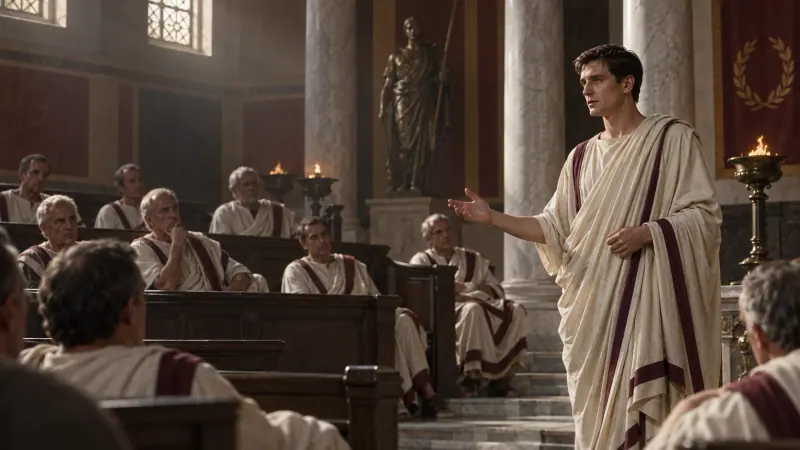
Octavian receives the name Augustus in Rome.
Understand the event
Questions people ask
How did Cleopatra die?+
Her death is generally understood as suicide after Octavian captured Alexandria, but the precise method is uncertain. Snakebite and other poison stories appear in the ancient accounts.
When did Cleopatra die?+
In August 30 BC, shortly after Alexandria’s fall and Antony’s death. The often quoted exact day should not be treated as securely established.
How old was Cleopatra when she died?+
Plutarch says she was 39, consistent with the conventional birth year of 69 BC and death in 30 BC.
Did Octavian kill Cleopatra?+
The surviving accounts generally describe her taking her own life while under his control, despite his wish to preserve her for a triumph. They do not establish a murder by Octavian as the historical conclusion.
Where was Cleopatra buried?+
Plutarch says Octavian allowed her burial with Antony. His narrative places her final days in Alexandria, but it does not locate their burial precisely enough to identify a particular site on the ground.
Who ruled Egypt after Cleopatra?+
Octavian controlled Egypt through a Roman prefect. He later took the name Augustus. There was no new independent Ptolemaic queen or king.
Did all Cleopatra’s children die?+
No. Caesarion was killed after the conquest, while her children with Antony survived the immediate defeat. Cleopatra Selene later became queen of Mauretania.
Read the evidence
Sources and perspective
Sources are identified beside the sections they support. Ancient and medieval authors wrote from particular positions; a detailed story can still be partisan, late or uncertain. Archaeology can test an account without confirming every detail.