The Battle of Actium: the naval defeat of Antony and Cleopatra
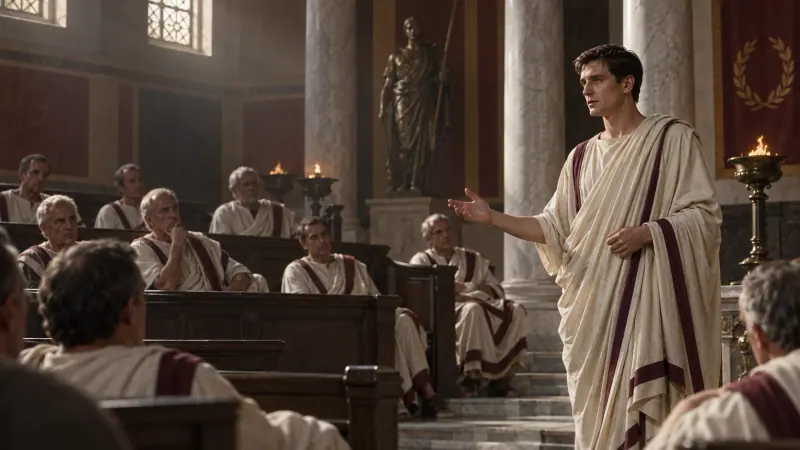
On 2 September 31 BC, Octavian’s forces defeated the fleet of Mark Antony and Cleopatra near Actium, at the entrance to the Ambracian Gulf in western Greece. Marcus Agrippa’s operations had already weakened their supplies and position. Antony and Cleopatra escaped by sea, but their coalition collapsed afterward. Actium made Octavian dominant in the Roman civil wars; the conquest of Egypt followed in 30 BC, and the name Augustus in 27 BC.
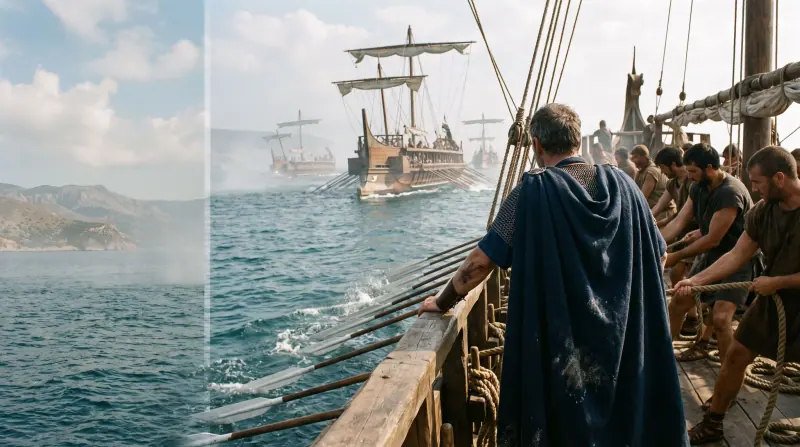
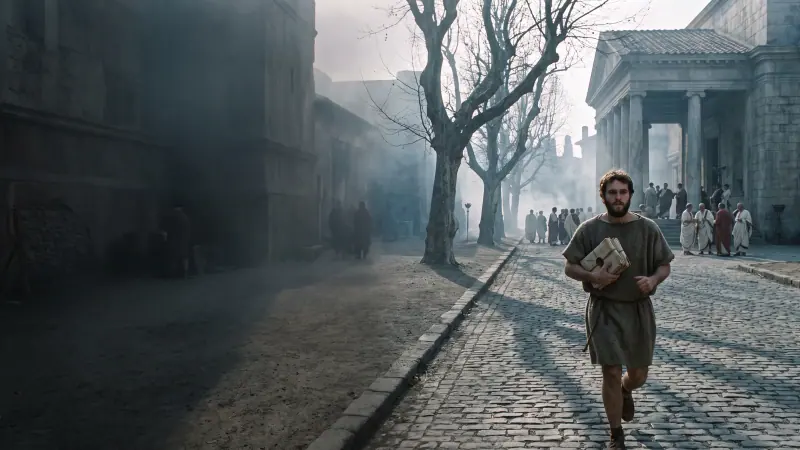
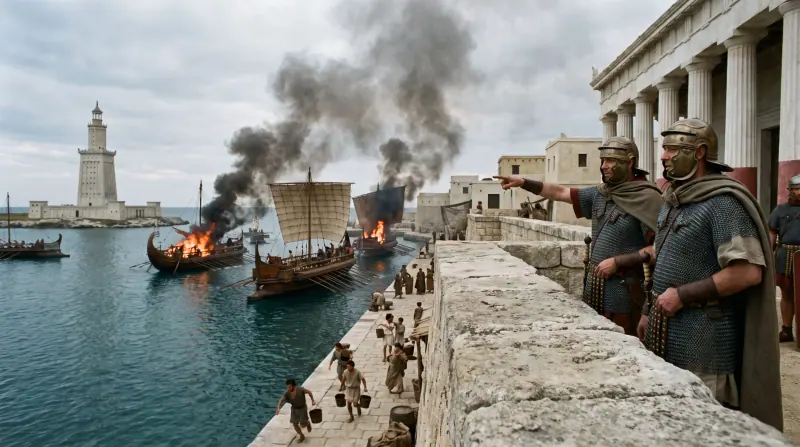
Western Greece, 2 September 31 BC. Antony and Cleopatra's fleet moves out from the Ambracian Gulf to face Octavian's forces. Agrippa's naval campaign has already weakened their supplies and narrowed their options. The fleets engage near Actium. Cleopatra's squadron escapes to sea, and Antony follows, leaving much of their strength behind. Their remaining coalition soon falls apart. Octavian holds the decisive advantage in Rome's civil war. The following year, he invades Egypt. Victory at Actium has opened the road to Alexandria and to a Roman world dominated by Caesar's heir.
Sources and context +
The historical guide below follows the people, events and surviving accounts behind this episode. Explore the sources.
Inside the episode
Cinematic scenes
Look closer at the individual moments within this story.
31 BC
Antony and Cleopatra after Actium
Antony and Cleopatra face the collapse of their coalition after returning to Alexandria.
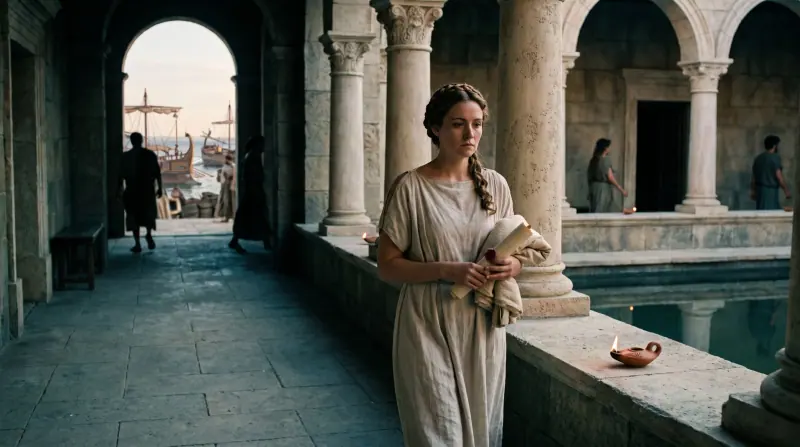
Alexandria, after Actium, 31 BC. Antony and Cleopatra have escaped the battle and returned to Egypt. Behind them, ships, soldiers and allies have slipped from their grasp. Together they command the resources of a kingdom, but Octavian holds the advantage. Their partnership has bound Roman military power to the wealth and ambitions of Egypt; now both face the same advancing enemy. They prepare for a final struggle while their position weakens. Within a year, Octavian will reach Alexandria, Antony and Cleopatra will be dead, and Egypt will pass under Roman rule.
Sources and context +
Antony and Cleopatra escaped Actium and returned to Egypt; their coalition then collapsed. Their partnership joined personal ties and political interests. This private encounter is imagined and does not establish a particular conversation, betrayal or emotional motive.
The historical guide below follows the people, events and surviving accounts behind this episode. Explore the sources.
The event at a glance
The essentials.
Date
2 September 31 BC
Wider conflict
War of Actium, 32–30 BC: the final civil war of the Roman Republic
Location
Outside the Ambracian Gulf, near modern Preveza, Greece
Winning side
Octavian, with Agrippa playing a central naval role
Opposing coalition
Mark Antony, Cleopatra VII and allied forces
Consequence
Collapse of Antony’s position; invasion of Egypt the following year
01
War of Actium vs Battle of Actium: what is the difference?
The War of Actium usually means the wider conflict of 32–30 BC between Octavian and the coalition of Antony and Cleopatra. Also called the final war of the Roman Republic, it included political rupture, campaigns by land and sea, the struggle around western Greece and the final conquest of Egypt. Roman soldiers and senators fought on both sides, even though the formal declaration targeted Cleopatra.
The Battle of Actium was the naval encounter on 2 September 31 BC within that war. It broke Antony’s position but did not kill either Antony or Cleopatra, who escaped to Egypt. The war ended with Octavian’s conquest in 30 BC. Cleopatra’s death and Egypt’s annexation explain that ending; the settlement of 27 BC explains the later political order. Those dates answer different questions.
Both men claimed the inheritance of Julius Caesar’s assassination. They had cooperated in the triumvirate, fought Brutus and Cassius, and divided responsibilities across Roman territories. Cooperation did not remove competition. Octavian built his position in the west, while Antony depended on eastern provinces, allied monarchs and his partnership with Cleopatra.
Antony’s marriage to Octavian’s sister Octavia had supported an earlier accommodation. Its breakdown, his relationship with Cleopatra and the distribution of eastern titles to her children supplied Octavian with powerful accusations. The Donations of Alexandria in 34 BC became particularly useful in portraying Antony as subordinating Roman interests to a foreign court.
War was formally declared against Cleopatra, but this was also a Roman civil war. Senators and Roman soldiers supported Antony as well as Octavian. Calling the conflict simply “Rome against Egypt” adopts the victor’s presentation and hides the struggle between rival Roman leaders. Cleopatra, meanwhile, was a sovereign with a fleet, resources and dynastic interests of her own.
Where was Actium, and what did Agrippa achieve before the battle?
Actium lay at the narrow entrance to the Ambracian Gulf on Greece’s western coast. Antony’s forces used the gulf and its surroundings as a base. Octavian established himself to the north of the entrance, while fleets and armies contested access, movement and supplies. The sheltered anchorage protected ships but could also make a fleet dependent on passing through a restricted outlet.
Agrippa’s campaign is essential to understanding the result. He attacked coastal bases, intercepted supplies and threatened communications before the famous naval encounter. Cassius Dio describes captures including Methone, Leucas and Patrae. Disease, desertion and provisioning problems reduced Antony’s ability to wait indefinitely. The battle followed months of pressure; it was not an isolated duel beginning with two equally fresh fleets.
The ancient accounts contrast many large ships on Antony’s side with more maneuverable vessels in Octavian’s fleet. Heavy ships could carry soldiers and missile weapons and were difficult to attack directly. Smaller craft could move more readily, cooperate against an opponent and exploit openings. Neither description makes size alone a guarantee of success.
Plutarch emphasizes close combat resembling assaults on fortified positions, with several attacking ships surrounding larger opponents. Dio also describes missiles, boarding attempts and eventual fire. Rowing crews, marines, commanders and signal coordination all mattered. These were human-powered warships fighting at limited distances, not later sailing ships exchanging broadsides of cannon.
Fleet totals vary with the source and the stage of the campaign being counted. Ships destroyed or discarded before battle, incomplete crews and support vessels complicate comparisons. Exact-looking diagrams assigning every hull a fixed starting coordinate can overstate what the surviving narratives establish. The broad contrasts in mobility and condition are more reliable than a single uncontested order of battle.
Why did Cleopatra leave, and why did Antony follow?
During the fighting Cleopatra’s squadron passed through an opening and sailed away; Antony followed. Plutarch makes this a dramatic demonstration of Antony’s dependence on her. Yet the same account notes preparations relevant to departure, including sails kept aboard when they were normally left ashore for battle. Dio also connects the action with an attempt to escape a deteriorating position.
These details make a planned breakout an important interpretation. They do not settle whether the commanders expected a full victory before withdrawal, how many ships they intended to save or why particular decisions were made at each moment. Saying Cleopatra suddenly betrayed Antony turns an unresolved military question into a moral certainty the evidence cannot bear.
The escape preserved the two leaders and part of their forces but left others fighting without them. Surviving ships and the land army did not sustain an effective campaign on Antony’s behalf. The political effect was decisive because a coalition held together by confidence and patronage became much harder to maintain after its commanders departed.
Actium: pressure, battle and breakout
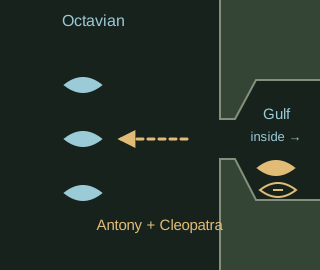
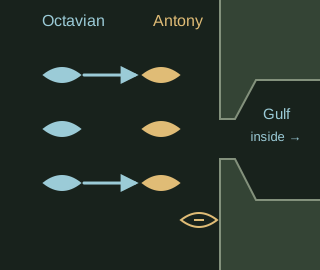
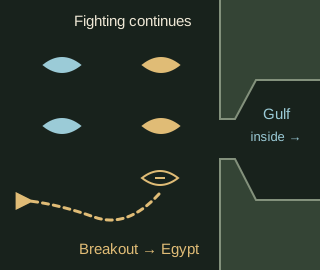
A schematic sequence drawn from Plutarch and Cassius Dio, not a reconstruction of every ship’s position. Blue ships represent Octavian’s fleet, gold ships Antony’s, and outlined ships Cleopatra’s squadron. Numbers of symbols are not fleet totals.
1. A constrained position
Agrippa’s attacks on bases and supplies weaken Antony’s position. The gulf offers shelter, but leaving it means passing through a narrow outlet.
2. The fleets engage outside
Antony’s fleet comes out to fight. Boarding, missiles and coordinated attacks matter alongside the different sizes and handling of the ships.
3. Cleopatra breaks through
Cleopatra’s squadron escapes and Antony follows. A planned breakout is an interpretation of their actions; the diagram cannot settle their complete intentions.
Octavian won. Agrippa’s contribution to the campaign and battle was central, even though Octavian was the leader who claimed the victory. Antony and Cleopatra survived the encounter and returned to Egypt; they did not die at Actium. The distinction matters because the final invasion, negotiations and deaths took place in the following year.
As Antony’s remaining forces and allies changed sides or submitted, Octavian advanced toward Egypt. Alexandria fell in 30 BC, Antony and Cleopatra died, and Egypt became a Roman province. The outcome gave Octavian access to the kingdom’s resources and removed his last comparable rival. His settlement of 27 BC then gave a durable political form to the supremacy won through war.
Octavian commemorated the victory with the city of Nicopolis, monuments and celebrations associated with Apollo of Actium. Nicopolis was a consequence of the victory, not a completed city overlooking the battle. The captured ships and the site of the victorious camp helped give a permanent geographical form to his account of events.
Augustus’s later Res Gestae presents the end of civil wars as the beginning of restored public order. Actium accordingly became more than a military success: it justified a new ruling position. Reading that presentation beside the campaign reveals both truths at once. The victory helped end a destructive contest for power, and it was itself achieved through another war between Roman coalitions. It also ended the prospects of a dynasty whose earlier survival had depended on Caesar’s intervention in Alexandria.
Antony, Octavian and Lepidus form the Second Triumvirate.
42 BC
Their victory at Philippi removes Brutus and Cassius.
34–32 BC
Antony’s eastern arrangements and the breakdown of his relationship with Octavian sharpen the conflict.
32 BC
War is formally directed against Cleopatra, although Romans fight on both sides.
Spring–summer 31 BC
Agrippa attacks bases and supply routes; the opposing armies gather around Actium.
2 September 31 BC
The fleets fight; Cleopatra’s squadron breaks out and Antony follows.
After the battle
Antony’s remaining military and political support unravels.
30 BC
Octavian conquers Egypt; Antony and Cleopatra die, ending the war.
27 BC
The later political settlement gives Octavian the name Augustus.
Understand the event
Questions people ask
Who won the Battle of Actium?+
Octavian’s side won, with Agrippa playing a crucial role in the naval campaign. Octavian later received the name Augustus.
Was the War of Actium the same as the Battle of Actium?+
No. The war lasted from 32 to 30 BC and ended with Octavian’s conquest of Egypt. The naval battle near Actium on 2 September 31 BC was its decisive encounter, followed by another year of conflict.
When and where was Actium fought?+
On 2 September 31 BC near the entrance to the Ambracian Gulf in western Greece, close to modern Preveza.
Did Cleopatra betray Antony at Actium?+
The sources do not securely establish that. Her departure is often interpreted within a planned breakout, although the commanders’ complete intentions and the battle’s precise sequence remain debated.
Why did Antony lose?+
Agrippa’s pressure on supplies and bases, disease and defections weakened his coalition before battle. The naval defeat and the leaders’ departure then accelerated its collapse. A single explanation based only on Cleopatra’s influence is inadequate.
Did Antony and Cleopatra die at Actium?+
No. They escaped to Egypt and died after Octavian’s conquest of Alexandria in 30 BC, the following year.
Did Actium end the Roman Republic?+
It was decisive in removing Octavian’s strongest rival, but the political transition unfolded over years. Egypt fell in 30 BC, and the settlement of 27 BC conventionally marks the start of the Augustan principate.
Read the evidence
Sources and perspective
Sources are identified beside the sections they support. Ancient and medieval authors wrote from particular positions; a detailed story can still be partisan, late or uncertain. Archaeology can test an account without confirming every detail.