Who was Boudica, queen of the Iceni?
Boudica was the wife of Prasutagus, king of the Iceni, a people living around modern Norfolk, northern Suffolk and eastern Cambridgeshire. Prasutagus ruled as a king allied to Rome, an arrangement Tacitus describes as an old Roman habit of using kings as instruments of rule. Tacitus calls him famous for his long prosperity. Nothing reliable survives about Boudica’s birth, age or life before the crisis. She enters the record as a widow, and every ancient description of her was written by Romans who had never seen her.
Her name appears in several forms. Tacitus’s text is usually printed as Boudicca, Dio writes Buduica, and modern historians generally prefer Boudica. The familiar Boadicea has no ancient authority; the London Museum calls older spellings a historical mistake. Like Arminius before the Teutoburg disaster of AD 9, Boudica came from inside Rome’s network of allied rulers rather than from a people untouched by Roman power. The revolt began with the collapse of that alliance, not as resistance to a sudden invasion.
Evidence: Tacitus · Annals 14.29–39 · Tacitus · Agricola 5 and 14–16 · London Museum · Boudica: Rebel queen of the Iceni
Why did Boudica rebel against Rome?
Tacitus says Prasutagus named the emperor Nero as co-heir with his two daughters, hoping to protect his kingdom and household. After his death the opposite happened. Centurions plundered the kingdom and slaves plundered the royal household. Tacitus says Boudica was flogged and her daughters raped. Leading Iceni lost their family estates, and the king’s relatives were treated as slaves. The kingdom was being absorbed into the province, and the Iceni took up arms in fear of worse to come.
Their neighbours had grievances of their own. Tacitus says the Trinovantes resented the veterans at Camulodunum, who drove people from their homes and land, and the temple of the deified Claudius, whose priests had to pour out their wealth on its cult. Dio, writing much later, gives financial causes: the procurator demanded repayment of money Claudius had given leading Britons, and Seneca suddenly called in large loans. The speeches both historians give Boudica are literary compositions, not records of her words.
Evidence: Tacitus · Annals 14.29–39 · Cassius Dio · Roman History 62.1–12 · Tacitus · Agricola 5 and 14–16
When did Boudica’s revolt happen: AD 60 or 61?
Tacitus places the revolt in the consulship of Caesennius Paetus and Petronius Turpilianus, which corresponds to AD 61. Many historians nevertheless prefer AD 60. In the Agricola, Tacitus says Paulinus had two successful years in Britain before attacking Mona, after his predecessor died within a year of arriving; read against the governors’ likely dates, that sequence suits AD 60. The Annals also pack a long aftermath into the same year, ending with Turpilianus taking over the province after his consulship. Because Tacitus sometimes grouped provincial events from several years together, his year heading does not settle the question.
Archaeology cannot decide a one-year difference. Coins and pottery in burnt deposits show roughly when a fire happened, not the exact year. Institutions therefore write the date in different ways: the London Museum says around AD 60, MOLA writes AD 60/61, and the Colchester Archaeological Trust uses AD 61. The disagreement affects the chronology rather than the basic story. On either date the revolt fell in the reign of Nero, only a few years before the Great Fire of Rome in AD 64.
Evidence: Tacitus · Annals 14.29–39 · Tacitus · Agricola 5 and 14–16 · London Museum · Boudica: Rebel queen of the Iceni · MOLA · Roman fort built in response to Boudica’s revolt · Colchester Archaeological Trust · The Fenwick Treasure (2014)
How did the rebels take Colchester and defeat the Ninth Legion?
Camulodunum was a colony of Roman veterans and the centre of the cult of the deified Claudius. Tacitus says it had no defensive walls. The procurator Catus Decianus sent no more than two hundred poorly armed men, secret supporters of the rebels hindered preparations, and the defenders who gathered in the temple held out for two days before it was stormed. Excavation confirms a violent end. In 2014 the Colchester Archaeological Trust found gold and silver jewellery buried beneath the floor of a house that then burned, with burnt food and human remains nearby.
Petillius Cerialis, commander of the Ninth Legion, marched to relieve the colony and was routed. Tacitus says his infantry were killed while Cerialis escaped with the cavalry to his camp. Historians generally think he had only part of the legion with him, and the Ninth was not wiped out: Tacitus later says its losses were made good with soldiers sent from Germany. Catus, whose greed Tacitus blames for provoking the war, fled to Gaul. The rebels had beaten a legionary force, and the governor’s army was far away.
Colchester Castle, built on the foundations of the Temple of ClaudiusEvidence: Tacitus · Annals 14.29–39 · Colchester Archaeological Trust · The Fenwick Treasure (2014) · Cassius Dio · Roman History 62.1–12
Why did the Romans abandon London?
When the revolt broke out, the governor Gaius Suetonius Paulinus was attacking Mona, modern Anglesey, which Tacitus calls a haven for refugees. Tacitus describes Druids and women with torches on the shore, the Roman crossing and the cutting down of sacred groves. News of the rising reached Paulinus while he was garrisoning the island. Agricola, Tacitus’s father-in-law, was then a young officer serving under the governor, so the account may draw on a witness close to events, although Tacitus wrote decades later.
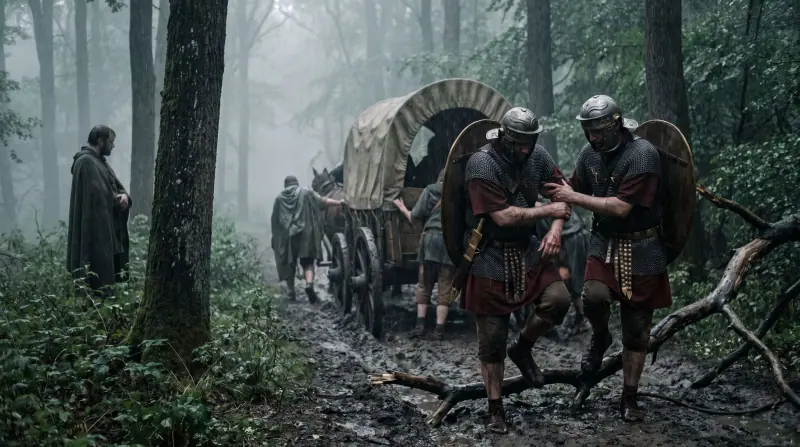
Tacitus says Paulinus marched through hostile country to London, then a busy trading centre without the status of a colony. Weighing his small force and Cerialis’s defeat, he decided to sacrifice one town to save the province. Ignoring the pleas of the inhabitants, he took those able to march with his column. Those who could not or would not leave were caught by the rebels. Verulamium suffered the same fate. Tacitus says the rebels bypassed forts and garrisons and went where plunder was richest and defence weakest.
Evidence: Tacitus · Annals 14.29–39 · Tacitus · Agricola 5 and 14–16 · Cassius Dio · Roman History 62.1–12
Did Boudica burn London and St Albans?
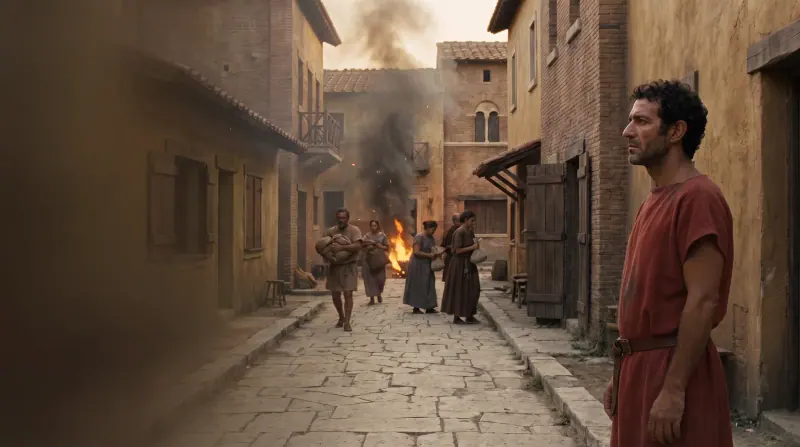
Yes, according to both the Roman historians and the archaeology. In central London, excavations have found thick layers of burnt debris from the revolt. The London Museum holds pottery and personal possessions from buildings burned by Boudica’s army, along with four engraved gemstones for rings that were buried in Eastcheap at about the same time, possibly hidden by their owner. MOLA describes the early Roman town as razed to the ground. Verulamium was also destroyed, although Tacitus gives fewer details about it than about London.
Tacitus says about 70,000 Roman citizens and allies died in the towns, and Dio gives a total of 80,000. These are ancient claims, not counts. Neither author could have had reliable figures, and both were writing dramatic history. Tacitus says the rebels took no prisoners for sale and killed those they caught. Dio adds lurid stories of atrocities against captive women, which read like stock images of barbarian cruelty and cannot be checked. Archaeology confirms the destruction, but burnt buildings cannot be turned into a death toll.
St Albans Museums: Roman VerulamiumEvidence: London Museum · Boudica: Rebel queen of the Iceni · MOLA · Roman fort built in response to Boudica’s revolt · Tacitus · Annals 14.29–39 · Cassius Dio · Roman History 62.1–12
Where was Boudica’s final battle?
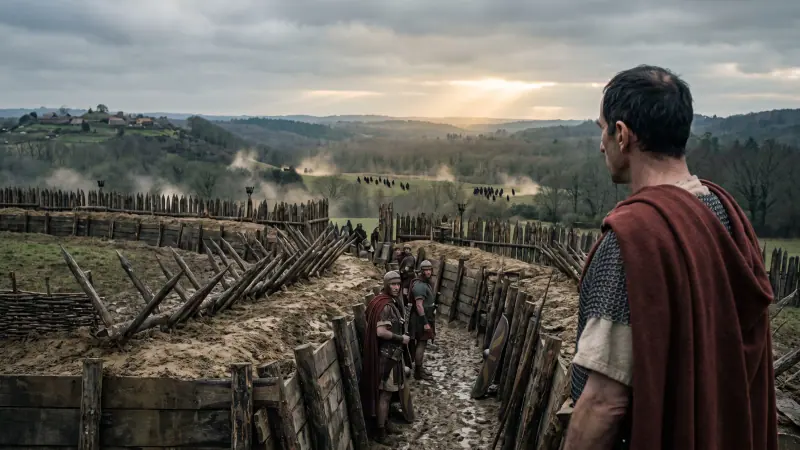
Paulinus gathered the Fourteenth Legion, part of the Twentieth and auxiliaries from nearby posts, about 10,000 men according to Tacitus. Poenius Postumus, camp prefect of the Second Legion, ignored orders and stayed away. Paulinus chose a position approached through a narrow defile with woodland behind, facing open ground that offered no cover for an ambush. The Britons came in vast numbers and placed wagons carrying their wives at the edge of the plain. The Romans threw their javelins, advanced in wedge formation and broke the British army; the wagons blocked its escape.
The site is unknown. Tacitus describes the landscape but names no place, and Dio adds nothing to fix it. Because Paulinus was probably moving along Watling Street, the Roman road from London to the north-west, many suggestions lie near it, including Mancetter in Warwickshire. These are guesses; no battlefield has been securely identified, and the London Museum says only that it was probably in the Midlands. Citing some accounts, Tacitus reports almost 80,000 British dead against about 400 Romans, while Dio gives Boudica 230,000 fighters. Both figures are implausible claims.
Evidence: Tacitus · Annals 14.29–39 · Cassius Dio · Roman History 62.1–12 · London Museum · Boudica: Rebel queen of the Iceni
How did Boudica die, and what changed afterwards?
The two ancient accounts disagree. Tacitus says Boudica ended her life with poison after the defeat. Dio says she fell ill and died while survivors prepared to fight again, and that the Britons mourned her and gave her a costly burial. Neither author explains how he knew. The London Museum considers poison more likely, since capture would have meant humiliation and probably execution. Her burial place is unknown, and there is no evidence for the story that she lies beneath King’s Cross station. Poenius Postumus killed himself after the victory.
Rome responded with force. Nero sent 2,000 legionaries, eight auxiliary cohorts and 1,000 cavalry from Germany, and Tacitus says peoples thought hostile or wavering were ravaged. Famine followed, because the rebels had neglected their sowing. The new procurator, Julius Classicianus, clashed with Paulinus and told Rome that peace would not come while he remained. The freedman Polyclitus was sent to investigate, and Paulinus was later replaced by Petronius Turpilianus, whom the Agricola credits with milder rule. In London, MOLA has found a large fort built in AD 63 in response to the revolt.
Evidence: Tacitus · Annals 14.29–39 · Cassius Dio · Roman History 62.1–12 · Tacitus · Agricola 5 and 14–16 · London Museum · Boudica: Rebel queen of the Iceni · MOLA · Roman fort built in response to Boudica’s revolt
What did Boudica look like, and how did Boadicea become a legend?
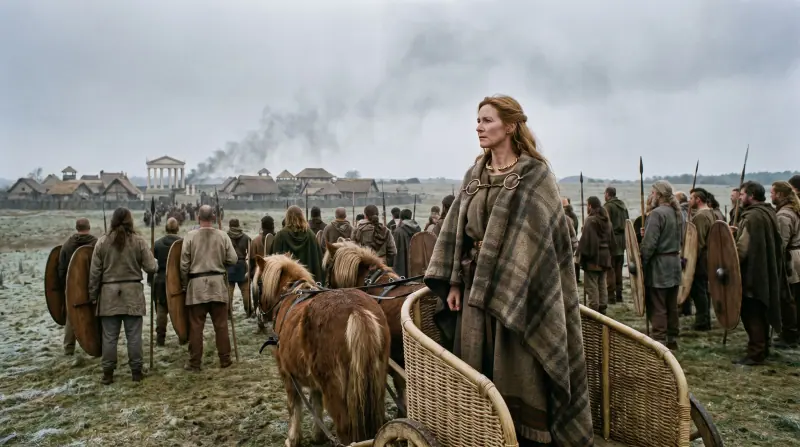
No portrait of Boudica survives. The famous description comes from Dio, writing well over a century later: very tall, terrifying in appearance, fierce of eye and harsh of voice, with a mass of tawny hair falling to her hips, a large gold necklace, a many-coloured tunic and a thick cloak fastened with a brooch. It is a literary portrait of a formidable barbarian queen, and the London Museum notes that such descriptions drew on stereotypes about northern European women. Modern images of a red-haired warrior queen descend from this passage.
Writers and poets retold her story from the sixteenth century onwards, often as Boadicea. William Cowper’s 1782 poem imagined her descendants ruling regions Caesar never knew, and Victorian Britain made her a patriotic emblem. Thomas Thornycroft’s bronze of Boadicea and her daughters was presented to London by his son and placed beside Westminster Bridge by the London County Council in 1902, with Cowper’s line on the plinth. Its chariot carries blades on the wheels, but the ancient accounts of the revolt mention chariots without scythes.
Evidence: Cassius Dio · Roman History 62.1–12 · London Museum · Boudica: Rebel queen of the Iceni · London Remembers · Boadicea statue, Westminster Bridge
Timeline
- Before the revolt
A colony of Roman veterans is settled at Camulodunum, where a temple to the deified Claudius becomes a focus of resentment.
- Shortly before the revolt
Prasutagus dies, naming Nero and his two daughters as heirs; Roman officials seize the kingdom and mistreat his family.
- AD 60 or 61
The governor Suetonius Paulinus attacks the island of Mona (Anglesey), far from the south-east.
- Opening of the revolt
The Iceni and Trinovantes destroy Camulodunum; the Temple of Claudius falls after two days, and part of the Ninth Legion is routed.
- Next phase
Paulinus reaches London but abandons it; the rebels burn Londinium and then Verulamium.
- Final battle
About 10,000 Roman troops defeat Boudica’s much larger army at an unidentified site; Boudica dies by poison or illness.
- Aftermath
Reinforcements arrive from Germany, hostile peoples are punished, and Petronius Turpilianus later replaces Paulinus.
- 1902
Thomas Thornycroft’s statue of Boadicea and her daughters is placed beside Westminster Bridge.
Questions people ask
Who was Boudica?
Boudica was queen of the Iceni, a people of what is now East Anglia, and the widow of King Prasutagus. She led a major revolt against Roman rule in Britain in AD 60 or 61.
Why did Boudica revolt against the Romans?
Tacitus says Roman officials seized the Iceni kingdom after Prasutagus died, Boudica was flogged and her daughters raped. The neighbouring Trinovantes resented the veteran colony at Colchester, and Dio adds disputes over recalled loans.
Did Boudica burn London?
Yes. Tacitus and Dio describe the destruction, and archaeologists have found thick layers of burnt debris in central London dating to the revolt. Colchester and Verulamium (St Albans) were also destroyed.
How did Boudica die?
The sources disagree. Tacitus says she took poison after her defeat; Dio says she fell ill and died, and that the Britons gave her a costly burial. Neither cause can be confirmed.
Where is Boudica buried?
Nobody knows. Dio mentions a costly burial but gives no place, and the London Museum notes that there is no evidence for the story that she lies beneath King’s Cross station.
Where was Boudica’s last battle?
The site is unknown. Tacitus describes a defile, woodland and an open plain but names no place. Locations along Watling Street, such as Mancetter in Warwickshire, are modern suggestions rather than proven sites.
What happened to the Ninth Legion in Boudica’s revolt?
Rebels routed a force from the Ninth Legion under Petillius Cerialis as it marched to relieve Colchester. Tacitus says the infantry were killed and Cerialis escaped with the cavalry; the legion was later brought back to strength.
Is it Boudica or Boadicea?
Boudica is the spelling most modern historians use. Boadicea, made famous by poets and the Westminster Bridge statue, rests on a later mistake rather than on the ancient texts.
Sources and perspective
Sources are identified beside the sections they support. Ancient and medieval authors wrote from particular positions; a detailed story can still be partisan, late or uncertain. Archaeology can test an account without confirming every detail.
- Tacitus · Annals 14.29–39
The fullest narrative, from the attack on Mona to the replacement of Paulinus, written in the early second century. Tacitus’s father-in-law Agricola served in Britain during the revolt, but the speeches are literary and the casualty figures unreliable.
- Cassius Dio · Roman History 62.1–12
Written in the early third century, well over a century after the revolt, and preserved only in a Byzantine abridgement. Adds financial causes, Boudica’s appearance and death by illness; its speeches, atrocity stories and army sizes are rhetorical.
- Tacitus · Agricola 5 and 14–16
Biography of Tacitus’s father-in-law, published about AD 98, in an older English translation. Agricola served under Paulinus during the revolt; the account is brief, written to honour him, and useful for the governors’ chronology.
- London Museum · Boudica: Rebel queen of the Iceni
Museum overview of the burnt layers in central London, related finds in its collection and the later legend. A modern summary that dates the attack to around AD 60.
- Colchester Archaeological Trust · The Fenwick Treasure (2014)
Excavation news on jewellery buried in a Colchester house destroyed in the revolt, with burnt food and human remains. Published as an early, provisional interpretation; the Trust dates the revolt to AD 61.
- MOLA · Roman fort built in response to Boudica’s revolt
Museum of London Archaeology summary of excavations at Plantation Place, dating the destruction of the early town to AD 60/61 and a new fort to AD 63.
- London Remembers · Boadicea statue, Westminster Bridge
Volunteer memorial record transcribing the plinth inscriptions, including the 1902 placement by the London County Council and the lines from Cowper. Evidence for the monument and its Victorian legacy, not for the ancient events.
Published . Updated . Research, authorship and corrections.
Report a historical correctionKeep your place in history.
Reading progress stays in this browser, on this device.
Choose your next episode