Why were Roman legions in Germania?
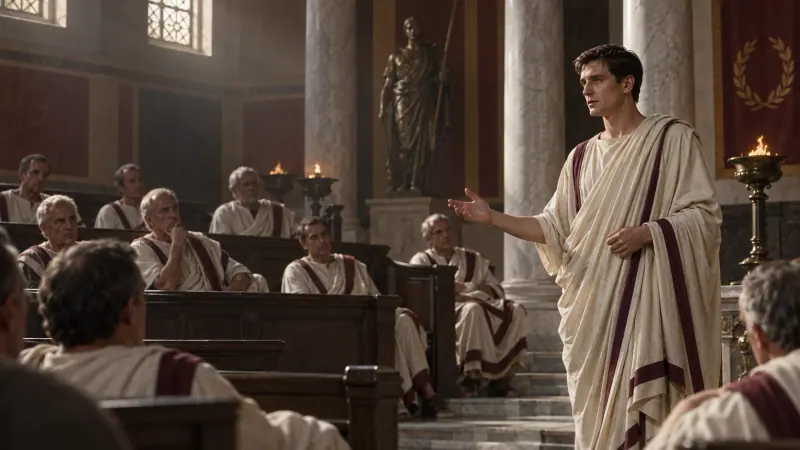
The battle grew out of imperial expansion under Augustus, Rome’s first emperor. Rome controlled Gaul and had pushed military operations across the Rhine, building forts and cultivating local allies. Its authority varied considerably from place to place. A commander could encounter markets, cooperating chiefs and Roman troops without possessing a stable province whose population accepted taxation and Roman justice.
Cassius Dio says Varus tried to accelerate the imposition of Roman government and financial demands. That is a later explanation, shaped by the knowledge that disaster followed. It nevertheless identifies a real political problem: military presence did not guarantee consent. The conquest of Gaul, exemplified by Caesar’s victory at Alesia, had encouraged Roman expectations of further expansion, but different communities and alliances could produce different outcomes.
Evidence: Cassius Dio · Roman History 56.18–24
Who were Arminius and Varus?
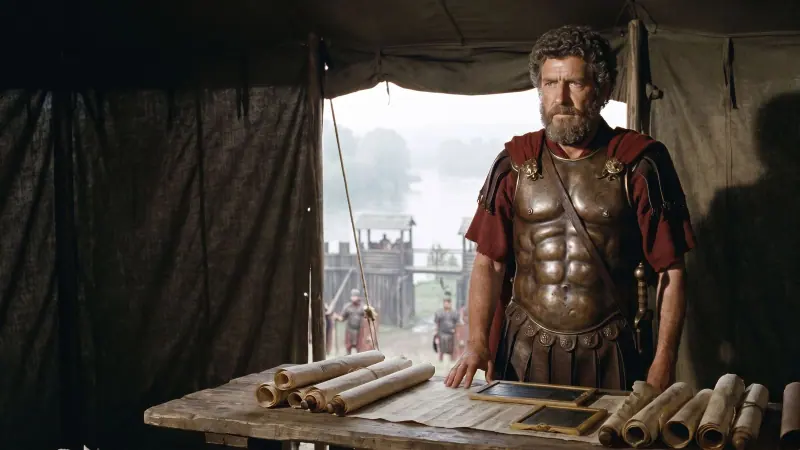
Varus was the Roman commander responsible for the army and the exercise of imperial authority. Arminius was a Cheruscan leader familiar with Roman service and military practice. The contrast was not simply between professional Romans and people who knew nothing of their methods. Roman recruitment and diplomacy created relationships through which local leaders learned how imperial forces moved and depended on allies.
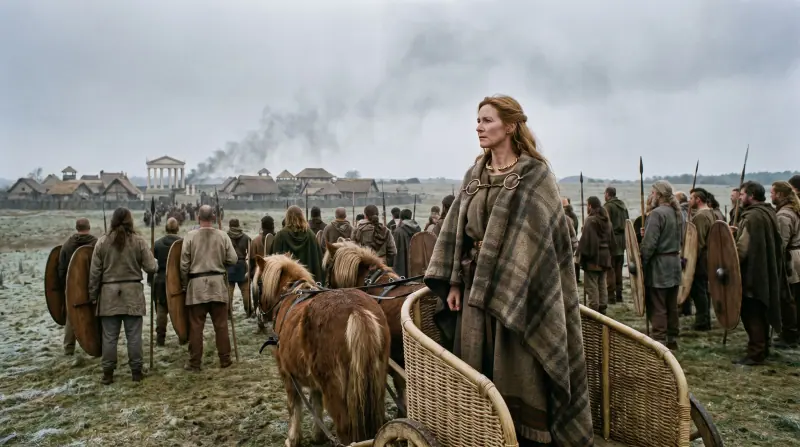
The coalition was also not a united German nation in the modern sense. Local loyalties differed, and some leading families supported Rome. Tacitus’s later account makes the hostility between Arminius and Segestes central to the story. Segestes had warned Varus and subsequently sought Roman protection. Treating every community east of the Rhine as permanently united conceals the political divisions that made both Roman intervention and resistance possible.
Evidence: Cassius Dio · Roman History 56.18–24 · Tacitus · Annals 1.55–71 · Velleius Paterculus · Roman History 2.117–120
How the ambush unfolded
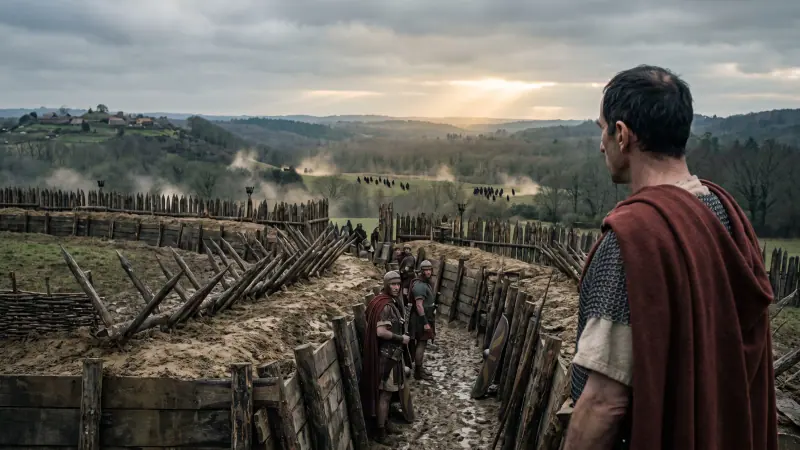
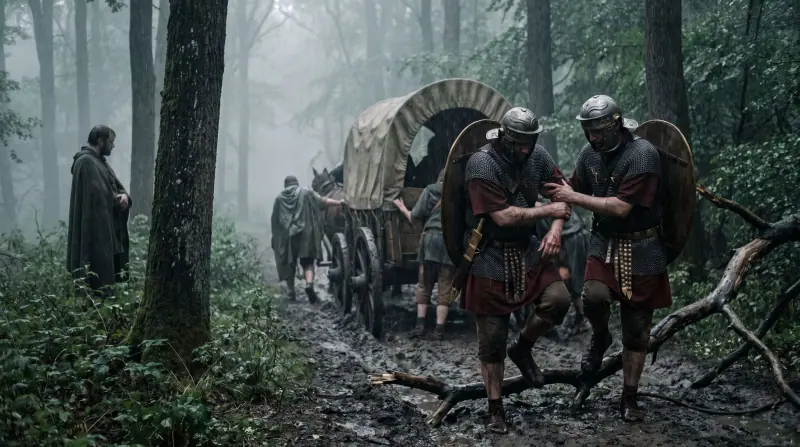
Dio describes a planned uprising at a distance from Varus’s position, followed by a march through supposedly friendly territory. Arminius and other leaders departed on the pretext of assembling auxiliaries. The Roman column included baggage wagons, servants and families as well as fighting troops. Difficult tracks and road work spread it out, while rain and wind made movement harder. Attackers who knew the routes could concentrate against exposed sections.
This was a sequence of engagements rather than one neat afternoon battle. The Romans established a camp, destroyed or abandoned unnecessary wagons and attempted to continue in better order. Dio then describes renewed forest fighting and worsening conditions, extending his narrative into a fourth day. The exact route, intervals and weather cannot be independently checked at every point. A confident day-by-day modern itinerary goes beyond what the evidence can support.
Evidence: Cassius Dio · Roman History 56.18–24
Why the Roman army lost
The decisive problem was the loss of coordinated movement. Roman infantry needed space to deploy, commanders needed to transmit orders, and the baggage train needed protection. Attacks along an extended column forced soldiers to respond locally while the army struggled to concentrate. Wet ground, obstructions, fatigue and accumulating casualties made each later movement harder. Superior equipment could not automatically solve those problems.
Dio reports that Varus and other officers killed themselves when defeat appeared inescapable. Many soldiers were killed or captured. Yet the statement that absolutely nobody survived is wrong: Tacitus describes survivors guiding Germanicus’s troops through the area years later. The three legions were destroyed as units, but their paper strength cannot be converted into an exact count of everyone killed, captured or able to escape.
Evidence: Cassius Dio · Roman History 56.18–24 · Tacitus · Annals 1.55–71
Where was the battle, and what does Kalkriese show?
Kalkriese, north of modern Osnabrück, is central to the archaeological identification of the disaster. Excavated military objects, coins and traces of conflict connect a constricted landscape with a substantial Roman defeat. Archaeology provides evidence independent of literary descriptions, while also revealing how much equipment was recovered, stripped or redistributed after fighting.
Even a major discovery does not settle every tactical question. A 2025 geoarchaeological study questions both Germanic-rampart and Roman-camp interpretations of sampled earthworks, proposing medieval dates for the investigated structures. The authors caution that those results cannot simply be extended across the whole site. A reconstruction should therefore distinguish excavated features from an imagined continuous ambush route, and should not treat one famous diagram as a photograph of the battle.
Evidence: Museum and Park Kalkriese · Battlefield research and exhibition · Härtling and colleagues · Germanic Rampart or Roman Encampment? (2025)
Roman retaliation and the battle’s significance
Rome reinforced its position on the Rhine, and campaigns continued after Augustus’s death. Tacitus describes Germanicus visiting the disaster area in AD 15, hearing survivors’ accounts and burying the dead. Roman forces recovered lost standards during subsequent operations. These campaigns demonstrate that Teutoburg did not make the region permanently inaccessible or destroy Rome’s capacity to fight.
Its lasting importance lies in the costs and limits of expansion. Rome retained formidable armies and controlled territory on the western side of the Rhine, while the attempt to impose sustained rule farther east had suffered a severe reversal. Much later, Marcus Aurelius’s Danube wars would again combine campaigning, diplomacy and the management of frontier peoples. Teutoburg was a major imperial disaster, not the birth of a modern nation or the inevitable cause of every later European boundary.
Evidence: Cassius Dio · Roman History 56.18–24 · Tacitus · Annals 1.55–71
Timeline
- Before AD 9
Roman campaigns, garrisons and alliances extend imperial influence beyond the Rhine.
- AD 9
Varus governs and campaigns in Germania while Arminius organizes resistance within the Roman alliance system.
- Opening of the ambush
According to Dio, a report of revolt draws Varus onto a vulnerable march; allied leaders leave to gather their own forces.
- Following days
Repeated attacks, difficult ground and bad weather fragment the column; soldiers abandon much of their baggage.
- Final collapse
Varus and senior officers take their own lives; the three legions cease to exist as organized formations.
- AD 15
Germanicus’s army visits the disaster area, buries remains and recovers a lost legionary eagle during its campaigning.
- AD 16 and after
Further Roman campaigns follow, but the Rhine remains the central military frontier in the region.
Questions people ask
Who won the Battle of Teutoburg Forest?
Arminius and his allied forces defeated the Roman army commanded by Varus in AD 9. Their attacks destroyed three legions and supporting forces as organized formations.
Which three Roman legions were lost?
Legions XVII, XVIII and XIX are associated with the Varus disaster. Auxiliary troops and noncombatants also accompanied the army; the total number of dead is uncertain.
Was Arminius a Roman soldier?
Arminius had experience of Roman military service and operated within Rome’s network of allied leaders before organizing resistance. That experience helps explain his knowledge of Roman methods.
Did anyone survive Teutoburg Forest?
Yes. Tacitus describes survivors of the battle or subsequent captivity identifying places and events for Germanicus’s army. The destruction of the legions does not mean every individual died.
How long did the battle last?
It unfolded over several days. Dio’s account reaches a fourth day; popular three-day summaries and exact modern dates should not be treated as a fully verified timetable.
Did Rome abandon Germania immediately?
No. Roman armies returned and fought major campaigns. The defeat seriously weakened attempts at lasting control east of the Rhine, but it was followed by retaliation and further political decisions.
Sources and perspective
Sources are identified beside the sections they support. Ancient and medieval authors wrote from particular positions; a detailed story can still be partisan, late or uncertain. Archaeology can test an account without confirming every detail.
- Cassius Dio · Roman History 56.18–24
Later Roman narrative of administration, the multi-day ambush and the response. Speeches, motives and precise movements require caution.
- Tacitus · Annals 1.55–71
Roman campaigning in AD 15, divisions among local leaders, recovery of a standard and survivors at the battlefield; written later.
- Velleius Paterculus · Roman History 2.117–120
Near-contemporary Roman account describing Arminius’s military experience and equestrian status; hostile stereotypes and praise of Tiberius shape the narrative.
- Museum and Park Kalkriese · Battlefield research and exhibition
The museum at the archaeological site presents excavation evidence and evolving interpretations.
- Härtling and colleagues · Germanic Rampart or Roman Encampment? (2025)
Primary geoarchaeological research proposing medieval dates for sampled structures. The authors explicitly limit extrapolation to the entire site and call for further dating.
Published . Updated . Research, authorship and corrections.
Report a historical correctionKeep your place in history.
Reading progress stays in this browser, on this device.
Choose your next episode