The struggle to keep the walls standing
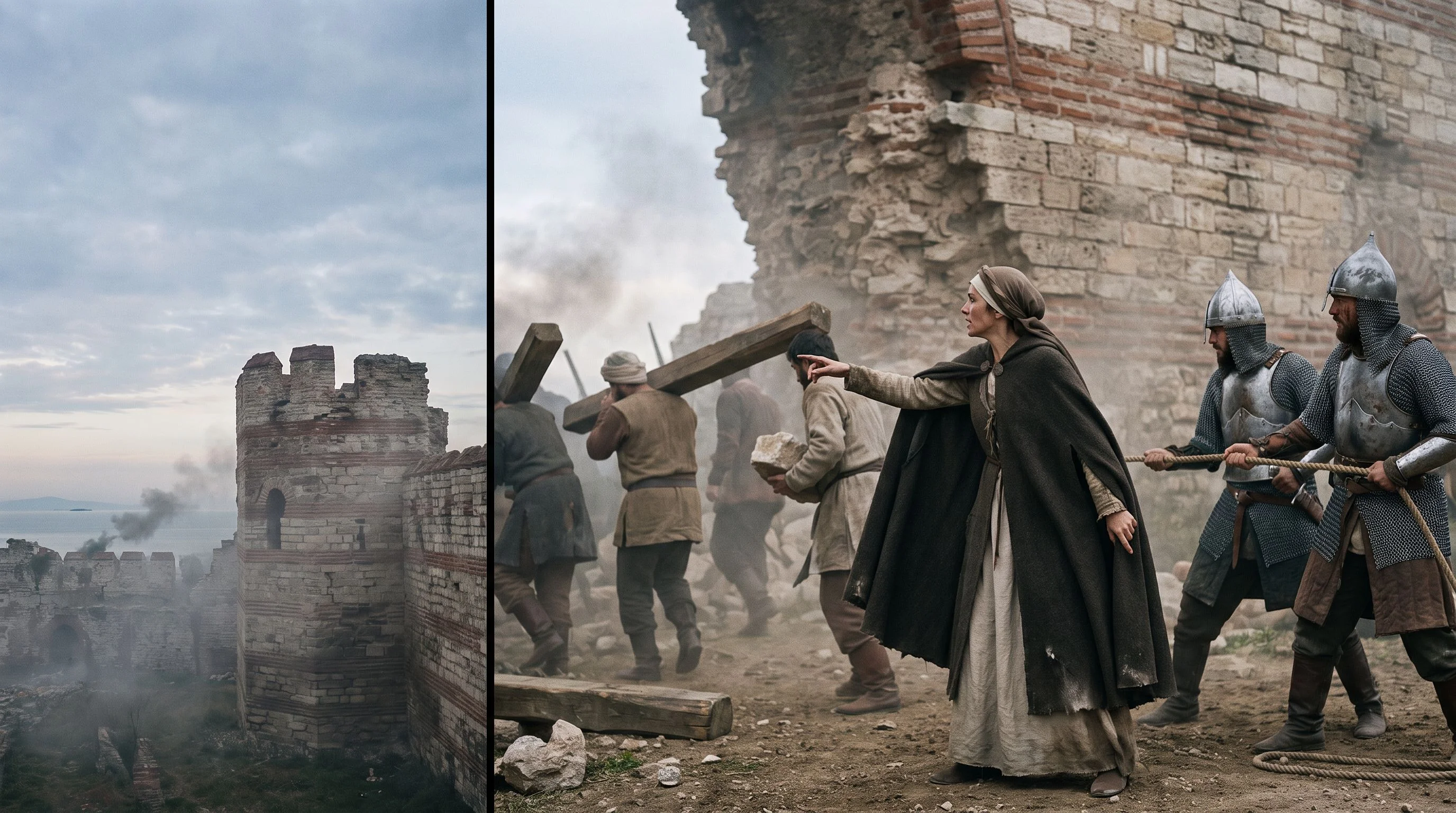
The Venetian eyewitness Nicolo Barbaro describes bombardment, repairs, watches and naval movements throughout the siege. Defending Constantinople required more than standing behind ancient masonry: damaged positions had to be rebuilt while men and supplies moved between threatened sectors. Cannon were not a new invention in 1453, but Ottoman artillery placed sustained pressure on an already stretched defence.
A Roman capital becomes an Ottoman city
Constantinople’s long history did not vanish with the conquest. Byzantine monuments and fortifications remained part of a city reshaped by Ottoman building, government and religious life. UNESCO’s account of Istanbul’s historic areas traces these overlapping legacies. Calling the event the end of the Byzantine Empire helps mark a political rupture, while the surviving city reveals both destruction and continuity.
Questions people ask
Who captured Constantinople in 1453?
The Ottoman sultan Mehmed II captured the city on 29 May 1453. Constantine XI, the last reigning Byzantine emperor, died during the final fighting.
Why is Constantinople part of Roman history?
Its rulers and inhabitants understood their state as Roman. “Byzantine” is a later historical label for the eastern Roman empire, whose capital and institutions survived long after western imperial rule.
Step into The Fall of Constantinople
The land walls are failing under heavy siege cannon. Move supplies, choose which damaged position to sustain, and organize a local evacuation before the end.
This episode is a planned playable documentary. You can explore its narrated opening and make one decision now. The three acts below describe the full story in development. Once completed, it will be free for everyone.
- The land walls
- Choose what to hold
- The last evacuation
Sources and perspective
Ancient accounts reflect their authors’ positions and often disagree. These sources inform the historical summary; dialogue, player roles and imagery in the documentary may be dramatized.
- Nicolo Barbaro · Diary of the Siege of Constantinople
An eyewitness narrative with a strongly Venetian and Christian perspective.
- UNESCO · Historic Areas of Istanbul
The city’s Byzantine and Ottoman monuments, fortifications and historical continuity.
An original historical guide by The Age of Rome. Updated 14 September 2026.