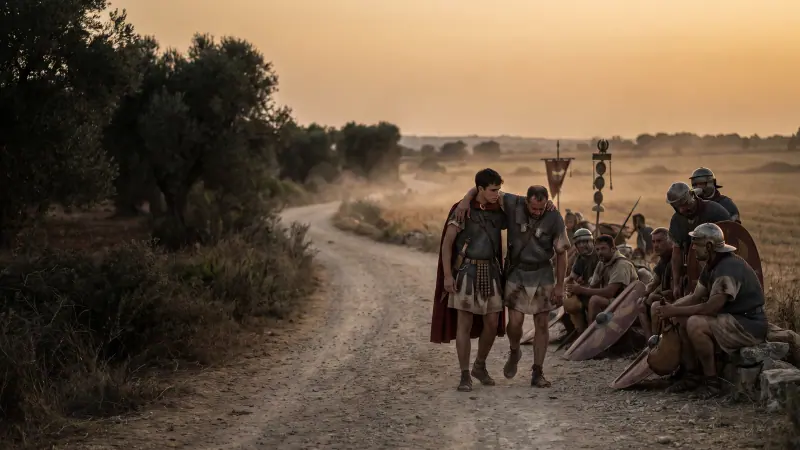
Why Hannibal and Rome fought at Cannae
Hannibal had invaded Italy to break the system of alliances that supplied Rome with soldiers and resources. His victories at the Trebia and Lake Trasimene had shown that confronting him on favourable ground could be disastrous. In 217 BC the dictator Quintus Fabius Maximus instead shadowed his army, threatened its supplies, and avoided a major engagement. That approach preserved Roman forces, but it also left allies exposed to campaigning and destruction.
In 216 BC Rome entrusted a much larger army to its two consuls. Hannibal’s occupation of Cannae, a position associated with Roman grain supplies, increased pressure to act. The open ground also favoured his cavalry. Rome’s decision was therefore a response to a real military problem, even though the battle became a demonstration of how superior infantry numbers could be neutralized.
Evidence: Polybius · Histories 3.107–118 · Livy · Periochae 22–23
Where is the Cannae battlefield today?
Cannae lies in the lower Ofanto valley in Puglia, the region called Apulia in ancient accounts. The hilltop site of Canne della Battaglia is inland from Barletta, overlooking the river known to the Romans as the Aufidus. The settlement, the surrounding plain where the armies fought, and the modern archaeological park are related places, but they are not interchangeable.
Polybius describes open ground suitable for cavalry and a Roman formation with one wing beside the river. That setting helps explain the danger to Rome’s flanks. It does not provide modern coordinates for each formation. Our tactical diagrams explain the sequence without assigning an exact ancient river course or claiming a surveyed boundary for the battlefield.
Find Cannae in modern Puglia
North is up. This simplified locator shows the modern setting, not the ancient river course or an excavated battle line. Distances and coastlines are schematic.
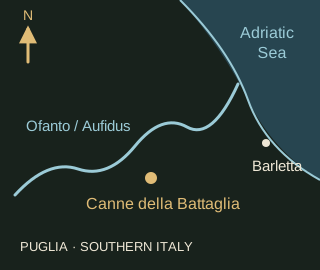
The lower Ofanto valley
Look inland from Barletta toward Canne della Battaglia. The hilltop settlement overlooks the valley associated with the ancient battle; its ruins are not a marked outline of the fighting.
Evidence: Polybius · Histories 3.107–118 · Musei Puglia · Canne della Battaglia · Italian Ministry of Culture · Canne archaeological park
Who commanded the armies, and how large were they?
Hannibal commanded a coalition rather than an army made up entirely of Carthaginian citizens. It included African, Iberian and Gallic infantry, Iberian and Gallic cavalry, and Numidian horsemen. Hasdrubal commanded the cavalry on his left, while Hannibal and his brother Mago stayed with the infantry centre. This Hasdrubal should not automatically be confused with Hannibal’s brother of that name.
On the Roman side, Paullus and Varro shared command, alternating responsibility. Polybius reports about 80,000 infantry and more than 6,000 cavalry in the Roman army, against approximately 40,000 infantry and 10,000 cavalry under Hannibal. These are ancient estimates, and not every soldier counted necessarily fought in the main line. They establish the claimed imbalance, not a modern audited order of battle.
Evidence: Polybius · Histories 3.107–118
How Hannibal’s double envelopment worked
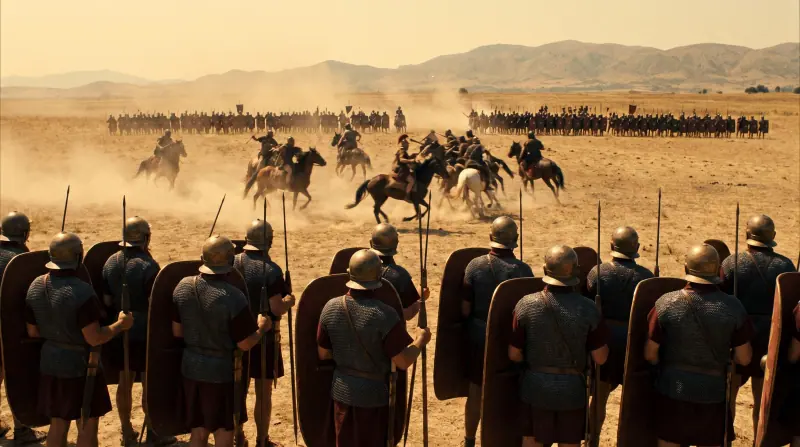
The Romans drew their infantry up unusually deep, hoping to break the opposing centre. Hannibal placed Iberian and Gallic infantry in a projecting curve, with African heavy infantry positioned farther back on either side. As the legions pressed forward, his centre gave ground. The curve flattened and then bent inward, drawing the advancing Romans beyond the African formations on their flanks.
The Africans turned inward and attacked both sides of the Roman mass. Meanwhile Hannibal’s left-wing cavalry had defeated the Roman horsemen beside the river, crossed behind the fighting, and helped drive away the allied cavalry on the opposite wing. Cavalry then struck the Roman infantry from the rear. This sequence is the double envelopment: pressure on both flanks followed by the closing of the rear.
Cannae in three movements
A schematic reading of Polybius 3.113–116. Gold shapes represent Hannibal’s forces; red blocks represent Roman infantry. Arrows show movement, not exact routes. No compass orientation or troop scale is implied.
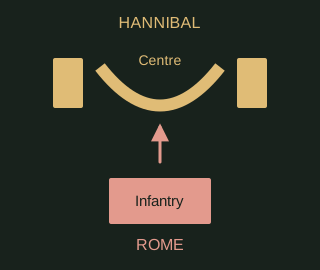
1. The Romans press forward
Rome concentrates its infantry against the projecting Iberian and Gallic centre. Hannibal’s African infantry stands farther back on either wing.
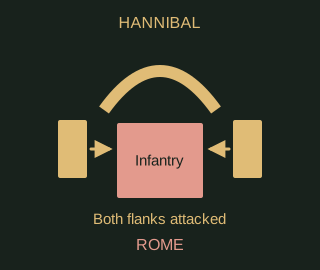
2. The flanks turn inward
The centre gives ground. The advancing Romans pass between the African formations, which turn against their exposed sides.
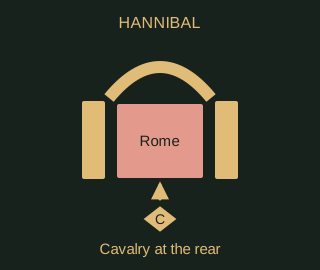
3. Cavalry closes the rear
After defeating the opposing horsemen, Hannibal’s cavalry attacks from behind. The infantry loses space to move and fight.
Evidence: Polybius · Histories 3.107–118
Why Rome’s greater numbers could not rescue the battle
Once surrounded, the Romans lost room to maneuver and bring their strength to bear. Men inside the compressed formation could not all reach the enemy; those on its edges had to turn and fight in several directions. What began as a concentrated attack became an enclosed struggle in which command, movement and escape grew progressively harder.
The plan also demanded more than a clever shape on a map. Hannibal’s centre had to survive the initial pressure, his African infantry had to turn at the right moment, and his cavalry had to return to the decisive fighting. Compare the cavalry’s role here with its decisive return at Zama, when mounted forces would help defeat Hannibal himself.
Evidence: Polybius · Histories 3.107–118
Casualties, survivors and the problem of blaming Varro
Paullus died during the battle; Varro escaped. Polybius claims roughly 70,000 Roman and allied dead, while the Livian tradition gives a lower total. Exact losses cannot be recovered securely. The important conclusion is the destruction of a major army and the deaths of many officers and prominent citizens, alongside thousands captured or scattered.
Ancient accounts contrast the cautious Paullus with the aggressive Varro, who had command on the day of battle. Polybius’s praise of Paullus and hostility toward Varro require scrutiny, especially given his connections with the family of Paullus’s descendants. Tactical responsibility cannot be reduced to a verdict that one reckless man alone caused the disaster. Rome had collectively raised and committed this army.
Evidence: Polybius · Histories 3.107–118 · Livy · Periochae 22–23
Why Hannibal did not immediately capture Rome
Destroying an army in open country did not automatically provide the means to capture a large defended city. Hannibal also wanted to dissolve Rome’s alliance network. Cannae helped him attract new partners, including Capua, but many communities remained loyal to Rome. That uneven political response limited what the battlefield victory could achieve.
Rome mobilized additional manpower, including enslaved men enrolled for military service, and continued fighting in Italy and overseas. The Senate’s refusal to ransom prisoners signalled determination at a severe human cost. The famous question of whether Hannibal should have marched directly on Rome remains a counterfactual: the surviving accounts do not establish that the city would have fallen.
Evidence: Polybius · Histories 3.107–118 · Livy · Periochae 22–23
Visiting Canne della Battaglia: what survives?
The Antiquarium and archaeological park preserve the history of the settlement across many periods. Much of the visible hilltop town is medieval, including remains associated with its churches and fortifications. The regional museum’s account says archaeological evidence attributable to the battle of 216 BC has not yet been identified. Visiting the ruins therefore does not mean walking through a preserved Roman battle formation.
Use the museum and the view over the valley to understand the landscape. Check the official visitor page for current opening days, tickets and access arrangements before travelling; seasonal hours and special openings change.
Official park information and visiting detailsEvidence: Musei Puglia · Canne della Battaglia · Italian Ministry of Culture · Canne archaeological park
What Cannae changed, and what it did not
Cannae became an enduring example of coordinated infantry and cavalry overcoming a larger force. Its strategic lesson is less simple: a spectacular battle can fail to produce the political result its victor needs. Rome retained the resources, allied support and determination to continue a long war, eventually taking the fighting to Africa.
The defeat of Hannibal at Zama in 202 BC belongs to the same war; the destruction of Carthage in 146 BC belongs to a later one. Cannae also helps explain why later commanders feared encirclement: at Pharsalus, Caesar prepared an infantry reserve specifically to protect a vulnerable flank. These comparisons illuminate tactical problems without making every ancient battle a repetition of Hannibal’s plan.
Evidence: Polybius · Histories 3.107–118 · Livy · Periochae 22–23 · Polybius · Histories 15.9–19
Timeline
- 218 BC
Hannibal crosses the Alps and defeats Roman forces at the Trebia.
- 217 BC
Rome suffers another major defeat at Lake Trasimene; Fabius adopts a strategy of avoiding decisive battle.
- 216 BC, before the battle
Hannibal takes the supply centre at Cannae; the consuls bring an unusually large Roman and allied army against him.
- Battle: opening
Hannibal’s cavalry defeats the Roman right while his projecting infantry centre meets the legions.
- Battle: encirclement
The centre bends back, African infantry attacks both Roman flanks, and cavalry strikes the rear.
- After the battle
Survivors regroup; some Italian communities defect, but Rome raises further forces.
- 202–201 BC
Scipio defeats Hannibal at Zama; the following peace ends the war in Rome’s favour.
Questions people ask
Who won the Battle of Cannae?
Hannibal’s Carthaginian-led army defeated the Roman and allied forces commanded by Paullus and Varro in 216 BC. Paullus was killed; Varro escaped.
Where was Cannae?
Cannae was in Apulia in southern Italy, near the Aufidus River, now called the Ofanto. It was not near the city of Rome.
Can you visit the Cannae battlefield today?
You can visit Canne della Battaglia’s archaeological park and Antiquarium near Barletta. The surviving settlement spans several periods; its ruins do not mark an excavated battle line. Consult the official park page for current access details.
What is a double envelopment?
It is an attack around both sides of an opposing formation. At Cannae, African infantry struck the Roman flanks and cavalry attacked from behind while Hannibal’s centre held the Romans in front.
How many Romans died at Cannae?
Tens of thousands of Romans and Italian allies were killed. Polybius claims about 70,000 dead; other ancient accounts give lower totals. A single exact number should not be treated as established.
Did Hannibal use elephants at Cannae?
Elephants do not feature in the surviving battle narratives of Cannae. The decisive elements were the infantry formation and cavalry. The famous elephant attack belongs to the account of Zama.
Did Cannae end the Second Punic War?
No. Rome continued the war, and Hannibal was defeated at Zama in 202 BC. Peace followed in 201 BC.
Sources and perspective
Sources are identified beside the sections they support. Ancient and medieval authors wrote from particular positions; a detailed story can still be partisan, late or uncertain. Archaeology can test an account without confirming every detail.
- Polybius · Histories 3.107–118
The main surviving tactical account, written decades later. Troop totals, casualty figures and its contrasting portraits of the consuls need caution.
- Livy · Periochae 22–23
Ancient summaries of Livy’s books preserve the disaster, defections and emergency response. They are abbreviated evidence, not the full narrative.
- Polybius · Histories 15.9–19
The later battle and settlement explain why Cannae was not the war’s conclusion; Polybius wrote in a Roman political environment.
- Musei Puglia · Canne della Battaglia
The regional museum describes the settlement’s long occupation and the absence of identified archaeological evidence attributable to the battle of 216 BC.
- Italian Ministry of Culture · Canne archaeological park
Official location, surviving medieval structures and visitor information. Check the current listing for opening arrangements.
Published . Updated . Research, authorship and corrections.
Report a historical correctionKeep your place in history.
Reading progress stays in this browser, on this device.
Choose your next episode